
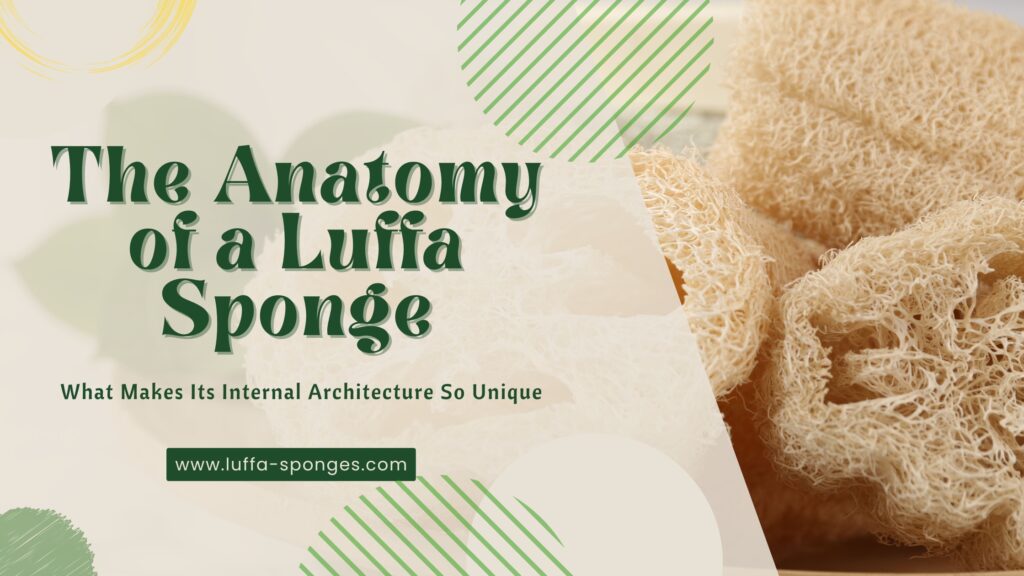
A Natural Engineering Marvel Most People Overlook
Few natural materials can match what a mature luffa sponge delivers through pure biological design. The anatomy of a luffa sponge internal structure is not a simple mesh of plant fibers. It is a precisely organized, three-dimensional vascular network that took millions of years of plant evolution to develop, and it is this architecture that explains why luffa outperforms synthetic alternatives in performance, durability, and environmental value.
For spa owners, retailers, and importers sourcing in bulk, understanding this internal structure directly informs quality evaluation, grading decisions, and supplier selection. For individual consumers and eco-conscious shoppers, it explains why a well-grown luffa feels different from a cheap imitation.
In this guide, you will learn exactly how a luffa sponge is built from the inside out, what biological systems create its texture and strength, how growing conditions affect structural quality, and what all of this means when you are buying or selling loofah products at any scale. By the end, you will have both the technical vocabulary and the practical knowledge to make better decisions, whether you are ordering a single sponge or placing a wholesale container order.
The Botanical Identity of the Luffa Plant
Before examining the internal anatomy of a luffa sponge, it helps to understand what kind of plant produces it. Luffa belongs to the Cucurbitaceae family, the same botanical family as cucumbers, squash, and melons. The two commercially significant species are Luffa aegyptiaca, also called the smooth luffa or Egyptian luffa, and Luffa acutangula, the ridged luffa grown primarily in Asia.
Luffa aegyptiaca is the species that produces the most commercially valuable sponge. It is the standard for bath and body products, spa applications, and industrial scrubbing because its internal fiber network forms a denser, more uniform structure than its ridged counterpart.
Why Egypt Dominates Luffa Cultivation
The Nile Delta region in Egypt provides a combination of sandy loam soil, consistent sun exposure, long warm growing seasons, and optimal humidity levels that no other region replicates at scale. These conditions allow the fibrovascular bundles inside the fruit to develop fully before harvest, producing a denser and more resilient sponge interior.
EGEXO has been exporting Egyptian loofah since 2015. Our loofah is grown in the Nile Delta. You can learn more about that process at the EGEXO Farm to Export page.
The Internal Architecture: Layer by Layer
The anatomy of a luffa sponge internal structure consists of multiple distinct layers and systems that work together. Understanding each one explains the sponge’s mechanical behavior, water absorption capacity, and durability under repeated use.
The Outer Skin and Epidermis
During growth, the luffa fruit is covered by a smooth, green skin that protects the developing fiber network inside. This outer skin is largely cellulose and acts as a pressurized container during the fruit’s development, which is one reason the internal fibers form under tension and emerge with natural spring and elasticity once the skin is removed.
When luffa is processed for commercial use, this outer skin is removed either by soaking in water until it softens and peels, or through mechanical peeling in large-scale operations. What remains after peeling is the fibrovascular skeleton, which is the actual product used in bath, kitchen, and industrial applications.
The Fibrovascular Network: The Core of Everything
The primary structural element inside a luffa sponge is its fibrovascular network, a three-dimensional lattice of cellulose fibers interlocked with vascular bundles that originally carried water and nutrients through the fruit during growth. This network forms the open-cell foam-like interior that consumers feel and use.
The fibers themselves are composed primarily of cellulose, hemicellulose, and lignin, the same compounds found in wood and plant stalks. However, unlike wood, the arrangement inside luffa is porous and interconnected rather than solid, which gives the sponge its characteristic combination of firmness and flexibility.
Key properties of the fibrovascular network include:
- Fiber diameter ranging from 0.1 to 0.3 millimeters per individual strand
- Void space (porosity) of 85 to 93 percent in a properly dried mature sponge
- Tensile strength sufficient to withstand repeated mechanical scrubbing without tearing
- Natural biodegradability with a decomposition timeline of 30 to 60 days under composting conditions
Vascular Bundles and Their Role in Structural Integrity
Running longitudinally through the sponge are the primary vascular bundles, the channels that transported fluids through the living fruit. After harvest and drying, these bundles become the structural spine of the sponge. They are denser than the surrounding mesh, slightly stiffer, and they run parallel to the long axis of the fruit.
This is why luffa sponges have directional strength. They are more resistant to tearing along their length than across it. For industrial and agricultural applications, this directional property can be engineered into product design. For bath use, it means the sponge maintains its tubular form during aggressive scrubbing.
The density and spacing of these vascular bundles is one of the primary indicators of quality in commercial grading. A higher bundle density indicates a mature, well-grown specimen with stronger overall architecture.
How Growing Conditions Alter Internal Structure
The anatomy of a luffa sponge internal structure is not fixed at the genetic level alone. Growing conditions heavily influence fiber density, bundle spacing, and the final porosity of the dried sponge. This is one reason why luffa from different regions performs differently even within the same species.
The Effect of Harvest Timing
Harvest timing is perhaps the single most important variable in determining internal structure quality. A luffa harvested too early will have underdeveloped fibers with lower tensile strength and a looser, more fragile mesh. A luffa harvested too late may have a brittle, over-lignified structure that crumbles under use.
The ideal harvest window is when the fruit has fully yellowed and begun to dry on the vine but before the outer skin becomes brittle and cracks. At this stage, the internal cellulose network has reached maximum fiber deposition without excess lignification.
Soil, Water, and Sun Exposure
Sandy loam soils with good drainage prevent waterlogging that can cause uneven fiber development. Consistent sun exposure encourages uniform cellulose deposition throughout the fruit. Excess irrigation dilutes nutrient availability and produces a thinner, less dense fiber matrix.
Egyptian cultivation conditions naturally satisfy all three requirements. You can read the EGEXO quality standards page.
Structural Properties That Determine Commercial Value
Understanding the anatomy of a luffa sponge internal structure gives both buyers and consumers a rational basis for evaluating quality. The table below maps internal structural features to commercial and consumer performance outcomes.
Structural Property to Performance Mapping
| Internal Structural Feature | What It Means for B2B Buyers | What It Means for Consumers |
|---|---|---|
| High fiber density (over 85 percent) | Lower defect rates, consistent product weight | Longer product lifespan under daily use |
| Uniform vascular bundle spacing | Predictable grading, reduced sorting costs | Even exfoliation across the skin surface |
| High porosity (88 to 93 percent) | Better water retention for spa applications | Rich lather production with soap or body wash |
| Full cellulose maturity | Resistance to compression and breakage in shipping | Maintains shape after weeks of regular use |
| Low lignin excess | Softer texture profile without sacrificing strength | Comfortable on sensitive skin |
| Clean seed cavity removal | Presentable product, reduced pest risk in storage | Hygienic, no debris trapped inside |
Luffa vs Synthetic Sponge: A Structural Comparison
| Feature | Natural Luffa | Synthetic Nylon Mesh | Synthetic Foam Sponge |
|---|---|---|---|
| Primary material | Cellulose and lignin | Petroleum-derived nylon | Polyurethane |
| Porosity | 85 to 93 percent | Varies, often 60 to 75 percent | 70 to 85 percent |
| Biodegradability | 30 to 60 days | 500 plus years | 500 plus years |
| Bacterial resistance | Moderate (improves with proper drying) | Low (traps bacteria easily) | Low (closed-cell traps moisture) |
| Mechanical durability | 4 to 8 weeks average daily use | 6 to 10 weeks but ecological cost high | 3 to 6 weeks |
| Skin feel | Firm, stimulating, improves circulation | Soft but lacks exfoliation depth | Soft, minimal exfoliation |
| Industrial suitability | High (filtration, composites, packaging) | Limited | Very limited |
For consumers making a purchasing decision and for retailers communicating product value, this comparison provides clear, evidence-based talking points. Browse the full range of bath and body luffa products to see how structural quality translates into finished product categories.
Industrial and Medical Applications Rooted in Structural Biology
The reason luffa has attracted serious research attention beyond the bathroom is entirely structural. The open-cell architecture of the fibrovascular network creates properties that scientists, engineers, and medical researchers have found genuinely useful.
Filtration and Composite Materials
The porous three-dimensional network of a dried luffa sponge is an effective medium for water filtration, particularly for removing suspended solids and certain heavy metals. Research published across agricultural engineering and environmental science journals has documented luffa’s effectiveness as a bio-filter medium because its irregular pore geometry creates high surface area contact with passing fluids.
In composite materials research, luffa fibers have been explored as reinforcement material in polymer matrices, replacing synthetic fibers like glass or carbon in low-stress applications. The cellulose content provides tensile reinforcement while the biodegradability of the final composite reduces end-of-life environmental impact.
Agricultural and Horticultural Uses
The same structural properties that make luffa effective for scrubbing make dried luffa segments useful as growing media in hydroponics and seed starting. The open porosity allows root penetration while retaining moisture uniformly, and the material breaks down in soil after use, adding organic matter.
Emerging Medical Research
Scientists have explored luffa-derived cellulose scaffolds for tissue engineering applications, where the three-dimensional fibrous matrix provides a structural template for cell growth. While this research is still largely at the experimental stage, it illustrates how deeply the internal architecture of the luffa sponge has captured scientific attention beyond its everyday uses.
For R&D buyers and technical procurement teams exploring industrial luffa applications, EGEXO offers custom supply arrangements through their custom loofah product design service.
Buyer Evaluation Checklist
When evaluating luffa quality from any supplier, use this checklist based on structural indicators:
| Evaluation Criteria | What to Look For | Red Flag |
|---|---|---|
| Fiber density when compressed | Should spring back immediately | Stays compressed or crumbles |
| Uniformity across the sponge | Even texture throughout | Thick ends, thin middle |
| Seed cavity | Clean, empty center | Seeds or debris present |
| Color consistency | Uniform throughout the batch | Dark spots, green patches |
| Moisture content | Dry to touch, no musty smell | Damp or moldy odor |
| Edge integrity | Fibers intact at cut ends | Fraying or fiber separation |
| Weight per unit | Consistent batch to batch | High variance within a lot |
Read the why choose EGEXO page.
Processing: How the Internal Structure Is Preserved or Damaged
The post-harvest processing of luffa is where many suppliers either preserve or destroy the structural integrity built during cultivation. Understanding this process helps buyers ask better questions and helps consumers understand why price differences between products exist.
The Processing Sequence
- Harvest at peak maturity (yellowed fruit, beginning to dry on vine)
- Initial water soak to soften outer skin (24 to 48 hours depending on method)
- Mechanical or hand peeling to remove epidermis
- Seed removal by shaking, washing, or tapping
- Bleaching or natural drying (this step has major quality implications)
- Grading by fiber density, size, and visual uniformity
- Cutting and shaping according to product specifications
- Packing and moisture-controlled storage for export
The bleaching step deserves particular attention. Chemical bleaching with chlorine compounds whitens the fiber quickly but damages cellulose bonds at the microscopic level, reducing tensile strength and shortening product lifespan. Natural sun drying and mild hydrogen peroxide treatments preserve structural integrity while achieving acceptable cosmetic appearance. Standard EGEXO loofah is not bleached. Bleaching is done only on request.
For consumers, this translates to a visible difference in how long a well-processed luffa holds up compared to a chemically over-treated one. For buyers, it affects defect rates, customer returns, and brand reputation. Browse raw loofah scrubbers to see minimally processed options ideal for industrial or custom downstream processing.
Expert Insight from EGEXO
Since 2015 we have exported Egyptian luffa, and we have learned that the internal structure of a luffa sponge is determined long before harvest. The decision of when to plant, how much water to apply during each growth phase, and how to manage vine spacing all affect fiber deposition at the cellular level. A luffa planted too densely competes for nutrients and produces thinner vascular bundles. A luffa irrigated inconsistently develops uneven fiber layers that look uniform on the outside but fail under repeated use.
Every product is checked before packing.
Samples are paid. The sample cost is credited to your first order of $1,000 or more, placed within 60 days. Reach us through the wholesale quotation page or explore our private label manufacturing service for branded product lines.
FAQ Section
Q1: What is the internal structure of a luffa sponge made of? A: The internal structure of a luffa sponge is composed of a three-dimensional network of cellulose fibers interlocked with dried vascular bundles. These bundles originally transported water and nutrients through the growing fruit. After harvest and processing, they form an open-cell fibrous skeleton with 85 to 93 percent porosity. The primary chemical components are cellulose, hemicellulose, and lignin, which together give the sponge its combination of flexibility, tensile strength, and biodegradability.
Q2: Why does Egyptian luffa have better internal structure than luffa from other countries? A: Egyptian luffa, specifically Luffa aegyptiaca grown in the Nile Delta region, benefits from sandy loam soil, consistent warm temperatures, and a long growing season that allows full fiber maturity before harvest. Egyptian loofah is softer, with a looser fibre weave than Asian loofah.
Q3: How does the internal anatomy of a luffa sponge affect its exfoliation performance? A: The exfoliation performance of a luffa sponge is directly linked to its fiber density and vascular bundle arrangement. Higher fiber density creates more surface contact points with the skin per square centimeter, producing deeper mechanical exfoliation. The directional strength of the vascular bundles allows the sponge to maintain its shape under pressure without collapsing, ensuring consistent scrubbing force throughout its lifespan. A sponge with loose, underdeveloped fiber structure will compress flat and provide minimal exfoliation benefit.
Q5: Can the internal fiber structure of luffa be used in industrial applications beyond bathing? A: Yes. The open-cell fibrovascular architecture of luffa has been studied and applied in water filtration systems, polymer composite reinforcement, hydroponic growing media, and early-stage biomedical scaffold research. The high surface area created by the porous three-dimensional fiber network makes dried luffa an effective filtration medium for suspended solids and certain heavy metals. In composite materials, luffa cellulose fibers provide reinforcement in biodegradable polymer matrices as a sustainable alternative to synthetic fibers.
Q6: How do I know if a luffa sponge has good internal structure before buying? A: For consumers, compress the sponge firmly and release it. A structurally sound luffa springs back immediately and returns to its original shape. Check the cut ends for fiber integrity rather than fraying. The sponge should feel uniformly dense rather than having soft spots or hard clusters. For wholesale buyers, request samples before placing bulk orders. EGEXO offers paid samples through its sample request page. The sample cost is credited to your first order of $1,000 or more, placed within 60 days.
Q7: How does harvest timing affect the anatomy of a luffa sponge internal structure? A: Harvest timing is the most critical variable in determining internal structural quality. Early harvest produces underdeveloped cellulose fibers with lower tensile strength and higher porosity than intended, resulting in a fragile sponge that breaks down quickly. Late harvest causes excess lignification, making fibers brittle and prone to crumbling under mechanical stress. The ideal harvest window is when the fruit has fully yellowed and begun to dry naturally on the vine. At this stage, fiber deposition is complete and lignin levels are appropriate for durable, flexible sponge architecture.
Q8: What is the difference between Luffa aegyptiaca and Luffa acutangula in terms of internal structure? A: Luffa aegyptiaca, the smooth luffa, produces a denser, more uniform fiber network with consistent vascular bundle spacing, making it the preferred species for bath, spa, and industrial applications. Luffa acutangula, the ridged luffa, has a less uniform internal fiber arrangement with thicker longitudinal ridges that create a coarser texture profile. For commercial sponge production, Luffa aegyptiaca is the global standard. Luffa acutangula is more commonly used as a culinary vegetable harvested young, before its fiber network fully matures.
Conclusion
The anatomy of a luffa sponge internal structure is a story of precision biological engineering. From the cellulose fiber network to the vascular bundles running through its core, every element of the luffa’s interior has a functional purpose that determines how it performs in daily use, commercial applications, and industrial settings.
For wholesale buyers, this structural knowledge translates into a rational quality evaluation framework. Fiber density, bundle spacing, harvest timing, and processing method are not abstract specifications. They are the measurable outcomes of growing and handling decisions that directly affect product performance, customer satisfaction, and return rates.
For consumers, understanding the internal architecture explains why a premium luffa feels different, lasts longer, and performs better than a low-cost alternative. It also explains why Egyptian luffa consistently outranks alternatives grown under less optimal conditions.
EGEXO has been exporting Egyptian loofah since 2015.
Key Takeaways:
- The internal structure of a luffa sponge is a three-dimensional cellulose and vascular fiber network with 85 to 93 percent porosity
- Egyptian luffa (Luffa aegyptiaca) produces the most commercially valuable and structurally consistent sponge globally
- Harvest timing and processing method determine whether structural quality is preserved or damaged
- The same structural properties that make luffa ideal for bathing also support industrial filtration, composite materials, and biomedical research
Ready to experience Egyptian loofah quality?
- For Wholesale Buyers: Request a quote or download our catalog
- Products: See our products or request samples