
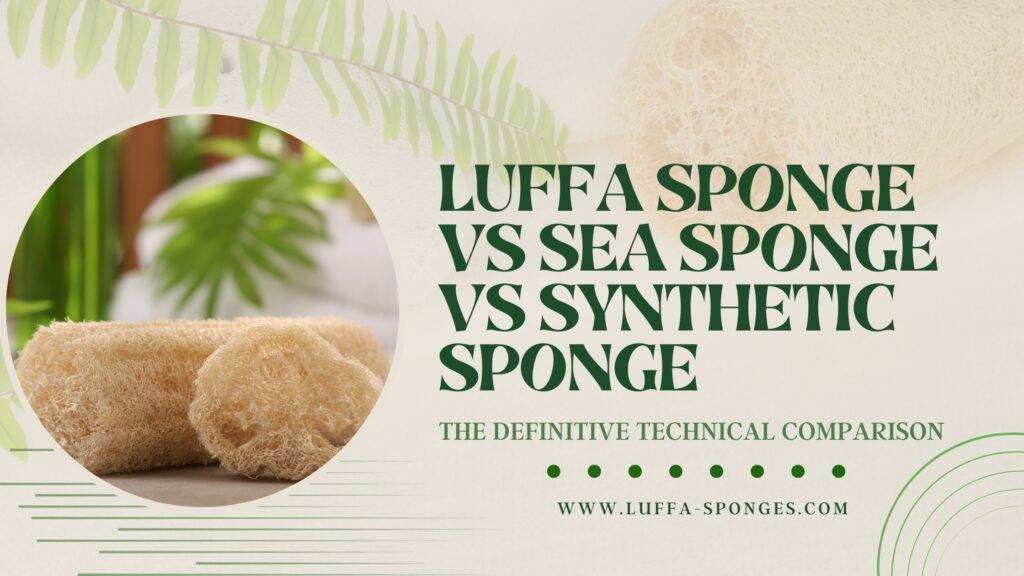
Three Sponges, One Clear Winner for Most Applications
Every year, the global sponge and scrubbing products market processes billions of units across bath, kitchen, medical, and industrial categories. Buyers at every level, from individual consumers choosing a shower sponge to spa chains sourcing by the container, face the same foundational question: which sponge type actually performs best for a given application, and what do the technical differences really mean in practice?
The luffa sponge vs sea sponge vs synthetic technical comparison is one of the most searched questions in the scrubbing products category, and for good reason. Each of these three sponge types comes from a completely different origin, carries different structural properties, and serves different use cases with varying degrees of effectiveness. Getting this decision wrong at the wholesale level means returns, complaints, and margin erosion. Getting it wrong as a consumer means spending more money more often on a product that underperforms.
This guide goes beyond surface-level comparisons. You will find detailed technical specifications, material science explanations, sustainability data, commercial grading information, and practical guidance for both individual buyers and bulk procurement teams. By the end, the right choice for your specific application will be clear, backed by measurable data rather than marketing language.
For additional consumer-focused guidance, Loofahguide.com provides practical product comparisons, and Wholesaleloofah.com covers bulk sourcing considerations in depth.
The Biological and Material Origins of Each Sponge Type
Understanding where each sponge comes from at the material level is the foundation for every performance comparison that follows. Origin determines chemical composition, structural architecture, availability, and ultimately commercial viability.
What Is a Luffa Sponge
A luffa sponge is the dried fibrovascular skeleton of the mature fruit of the Luffa aegyptiaca plant, a member of the Cucurbitaceae family. The sponge is not harvested from water. It grows on a vine, in open agricultural fields, under direct sunlight. The internal network is composed primarily of cellulose, hemicellulose, and lignin, arranged in a three-dimensional open-cell lattice with a natural porosity of 85 to 93 percent in well-grown specimens.
This plant-based origin means luffa is fully renewable, scalable through conventional agriculture, and biodegradable within 30 to 60 days under composting conditions. Egypt, specifically the Nile Delta region, produces the highest quality Luffa aegyptiaca in the world due to its combination of sandy loam soil, extended warm growing season, and consistent solar exposure. These conditions allow the internal fiber network to reach full structural maturity before harvest, producing a denser and more durable sponge than specimens grown under shorter or cooler growing seasons.
What Is a Sea Sponge
A sea sponge is an animal, specifically a member of the phylum Porifera, and the product sold commercially is the dried skeleton of this organism after it has been harvested from marine environments. Sea sponges are among the oldest multicellular animals on Earth, with a fossil record extending back over 600 million years. The commercial product is composed primarily of spongin, a flexible collagen-like protein fiber, though some species also incorporate silica or calcium carbonate spicules in their skeleton.
Sea sponges are harvested primarily from the Mediterranean Sea, the Caribbean, and parts of the Pacific. Wild harvesting raises significant ecological concerns and is subject to increasing regulation in many jurisdictions. Some aquaculture operations exist but have not scaled sufficiently to reliably supply commercial markets, which creates both availability constraints and price volatility for wholesale buyers.
What Is a Synthetic Sponge
Synthetic sponges are manufactured from petroleum-derived polymers, most commonly polyurethane foam, nylon mesh, or polyester fiber. The manufacturing process involves chemical foaming agents, plasticizers, and colorants, none of which are present in natural alternatives. The resulting product is uniform, inexpensive to produce at scale, and consistent in dimension and density. However, the environmental profile of synthetic sponges is broadly negative: they do not biodegrade, they shed microplastics with every use, and their production generates chemical waste streams that natural alternatives entirely avoid.
Technical Specifications: A Direct Material Comparison
The following table provides a direct side-by-side comparison of the three sponge types across the technical metrics most relevant to both B2B buyers and end consumers.
Master Technical Comparison Table
| Technical Metric | Luffa Sponge (Egyptian Grade A) | Natural Sea Sponge | Synthetic Polyurethane |
|---|---|---|---|
| Primary material | Cellulose, hemicellulose, lignin | Spongin protein fiber | Polyurethane polymer |
| Origin | Agricultural (plant-based) | Marine animal harvest | Petroleum manufacturing |
| Porosity | 85 to 93 percent | 70 to 85 percent | 60 to 80 percent |
| Fiber tensile strength | High (withstands mechanical scrubbing) | Moderate (tears under heavy pressure) | Variable (high initially, degrades with heat) |
| Biodegradability | 30 to 60 days composting | 60 to 180 days (natural environment) | 500 plus years (does not biodegrade) |
| Microplastic shedding | None | None | Yes (every wash cycle) |
| Bacterial resistance | Moderate (improves with proper drying) | Low to moderate | Low (closed-cell traps moisture) |
| Water absorption rate | Rapid, high volume | Rapid, very high volume | Moderate, slower saturation |
| Average useful lifespan | 4 to 8 weeks daily bath use | 6 to 12 months with proper care | 3 to 6 weeks average |
| Skin exfoliation level | Medium to high (mechanical fiber action) | Gentle to medium | Very low to gentle |
| Scalability of supply | Very high (agricultural crop) | Low (ecological and harvest limits) | Very high (industrial manufacturing) |
| Industrial applications | High (filtration, composites, packaging) | Very limited | Moderate (industrial foam applications) |
| Regulatory compliance | No restrictions | Increasing harvest regulations | Microplastic regulations emerging |
| Carbon footprint | Very low | Low to moderate | High |
Durability and Lifespan Data
| Sponge Type | Average Daily Use Lifespan | Lifespan with Proper Care | Replacement Frequency Per Year | Estimated Annual Units Per Consumer |
|---|---|---|---|---|
| Luffa (Egyptian Grade A) | 6 to 8 weeks | Up to 10 weeks | 5 to 8 times | 6 to 8 units |
| Luffa (standard grade) | 4 to 6 weeks | 6 to 7 weeks | 7 to 12 times | 8 to 12 units |
| Natural sea sponge | 3 to 6 months | Up to 12 months | 1 to 4 times | 2 to 4 units |
| Synthetic polyurethane | 3 to 5 weeks | 6 weeks maximum | 8 to 15 times | 10 to 15 units |
| Synthetic nylon mesh | 6 to 8 weeks | 10 weeks | 5 to 8 times | 6 to 8 units |
The sea sponge lifespan advantage over luffa is real and should be acknowledged honestly. However, sea sponge availability constraints, significantly higher unit cost, and ecological sourcing concerns make this advantage largely irrelevant for commercial buyers sourcing at scale. For premium spa applications where longevity and ultra-gentle texture justify the price differential, sea sponges retain a specific niche. For the vast majority of retail, wholesale, and industrial applications, Egyptian luffa provides the best overall value per unit across durability, performance, cost, and environmental profile.
Buyers interested in reviewing grade-specific luffa durability specifications can access the Egexo product catalog for detailed technical documentation.
Exfoliation Performance: The Science Behind Each Sponge’s Skin Interaction
For consumers and spa professionals, exfoliation performance is often the primary purchasing criterion. The technical comparison here reveals why luffa outperforms both alternatives for the majority of users and use cases.
How Luffa Exfoliates
The exfoliation mechanism of a luffa sponge is purely mechanical. The cellulose fiber network, when wet, creates hundreds of individual contact points per square centimeter across the skin surface. These fiber intersections produce controlled abrasion that removes dead skin cells from the stratum corneum, the outermost layer of the epidermis, without chemical agents or deep skin penetration.
The directional stiffness of luffa fibers, derived from the vascular bundles running longitudinally through the sponge, allows the user to apply varying pressure with consistent results. Firm pressure produces deeper exfoliation; gentle pressure produces surface-level skin renewal. This tunability of exfoliation intensity is one of the key advantages luffa holds over both sea sponge and synthetic alternatives.
How Sea Sponge Exfoliates
Sea sponge exfoliation is primarily physical but significantly gentler than luffa. The spongin fiber structure is softer and more elastic than cellulose. When wet, sea sponge fibers create a smooth, compressible surface rather than the firm, structured contact of luffa fibers. This produces a polishing rather than scrubbing action on the skin.
For newborns, people with sensitive skin conditions, or consumers recovering from dermatological procedures, sea sponge offers a gentler alternative. For consumers seeking genuine exfoliation depth, the sea sponge underdelivers compared to luffa, and many users supplement sea sponge with separate exfoliating products to achieve the results luffa provides on its own.
Why Synthetic Sponges Fall Short for Exfoliation
Synthetic polyurethane foam has almost no exfoliation capability. Its closed-cell or semi-open structure compresses entirely under skin contact, creating a smooth, uniform surface that generates no mechanical abrasion. Nylon mesh provides slightly more texture but lacks the three-dimensional fiber complexity of natural luffa, resulting in uneven or superficial exfoliation.
The marketing of synthetic sponges often emphasizes lather production rather than exfoliation because lather is the measurable benefit that synthetic materials can genuinely deliver. Consumers who purchase a synthetic sponge expecting exfoliation equivalent to a natural luffa consistently report disappointment. Retailers and spa owners stocking synthetic alternatives receive this feedback directly and face higher return and complaint rates in the exfoliation product category.
Shop the full range of bath and body luffa products to see how Egyptian-grown luffa translates the structural advantages described here into finished consumer products.
Environmental and Sustainability Profile: A Comparison That Matters More Each Year
Sustainability is no longer a secondary consideration for either consumers or commercial buyers. Regulatory trends, consumer purchasing behavior data, and supply chain risk assessments all point in the same direction: the environmental profile of a product is increasingly a primary commercial variable.
Luffa Sponge Sustainability Metrics
| Environmental Factor | Luffa Sponge | Sea Sponge | Synthetic Sponge |
|---|---|---|---|
| Renewable resource | Yes (annual crop) | Partial (slow regeneration) | No (petroleum-derived) |
| Biodegradable | Yes, 30 to 60 days | Yes, 60 to 180 days | No, 500 plus years |
| Microplastic pollution | None | None | Yes, every use |
| Agricultural land use | Moderate | None (marine) | Industrial facility |
| Carbon footprint per unit | Very low | Low | High |
| Packaging compatibility | Compostable packaging possible | Compostable packaging possible | Often paired with plastic packaging |
| Regulatory risk | Very low | Increasing harvest restrictions | High (microplastic regulations) |
| End-of-life disposal | Compost or soil amendment | Compost | Landfill only |
The microplastic issue deserves particular emphasis. Research from multiple environmental monitoring programs has documented that synthetic sponges and cleaning tools shed microplastic particles into wastewater systems with every washing cycle. These particles pass through most water treatment systems and accumulate in marine environments. Regulatory bodies in the European Union, United Kingdom, and increasingly in North American jurisdictions are advancing restrictions on microplastic-shedding products, which represents a significant medium-term commercial risk for synthetic sponge inventory.
Luffa carries none of this regulatory risk. Its end-of-life pathway is composting or direct soil amendment, and its production generates no synthetic chemical waste. For wholesale buyers constructing a forward-looking product portfolio, Egyptian luffa from a supplier like Egexo represents the most defensible long-term position in the scrubbing products category.
Commercial and Wholesale Considerations for Buyers
The luffa vs sea sponge vs synthetic technical comparison looks different from the perspective of a wholesale buyer than from an individual consumer. Supply chain reliability, minimum order quantities, quality consistency, and market positioning all factor into the commercial decision.
Supply Chain Reliability Comparison
| Factor | Luffa (Egyptian) | Sea Sponge | Synthetic |
|---|---|---|---|
| Supply predictability | High (planned agricultural crop) | Low (harvest season variability, regulations) | Very high (industrial manufacturing) |
| Quality consistency | High with certified supplier | Variable (natural organism variation) | Very high (manufacturing controlled) |
| MOQ flexibility | Moderate (500 to 5,000 units depending on grade) | High (small batches common at high cost) | Very high (factory minimums can be large) |
| Lead time | 4 to 8 weeks from order to export | 4 to 12 weeks (highly variable) | 2 to 6 weeks (factory location dependent) |
| Price stability | Moderate (agricultural commodity cycles) | Low (very volatile) | High (polymer commodity pricing) |
| Private label availability | Yes (common with quality suppliers) | Rarely available | Yes (manufacturing standard) |
| Certifications available | Organic, natural, export compliance | Limited | REACH, OEKO-TEX for some |
For retailers building a sustainable product line, Egyptian luffa offers the combination of supply reliability, quality consistency, and environmental credibility that neither sea sponge nor synthetic can match simultaneously. Egexo’s private label manufacturing service allows retailers and spa chains to develop branded luffa product lines backed by Egyptian cultivation quality and documented export compliance.
Supplier Evaluation Checklist for Wholesale Luffa Buyers
| Evaluation Criterion | What to Verify | Why It Matters |
|---|---|---|
| Cultivation origin | Confirmed Egyptian Nile Delta region | Ensures optimal growing conditions for fiber quality |
| Grading documentation | Written grade specifications per batch | Prevents quality variation across orders |
| Processing method | Natural drying versus chemical bleaching | Affects fiber integrity and consumer safety |
| Export certifications | Phytosanitary, quality, country of origin | Required for import compliance in most markets |
| Sample availability | Pre-order sample program | Allows quality verification before commitment |
| MOQ flexibility | Range across grade levels | Ensures supplier fits your order volume needs |
| Lead time commitment | Written timeline guarantees | Prevents inventory gaps |
| Private label capability | In-house production capacity | Reduces third-party risk in branding |
| Customer references | Verifiable wholesale client list | Confirms commercial reliability |
| Minimum experience | 10 plus years preferred, 25 plus years optimal | Predicts consistency and problem-solving capability |
Egexo satisfies all ten criteria on this list, operating with over 25 years of documented cultivation and export experience. Their quality standards documentation covers grading criteria, processing protocols, and compliance certifications in detail. Buyers can initiate the evaluation process by ordering samples before any commercial commitment.
Application-by-Application Recommendation Guide
Different use cases genuinely favor different sponge types. This section provides direct recommendations across the most common applications, backed by the technical data covered in earlier sections.
Application Suitability Matrix
| Application | Best Choice | Runner-Up | Avoid |
|---|---|---|---|
| Daily adult body exfoliation | Luffa (Grade A) | Sea sponge (gentler) | Synthetic foam (no exfoliation) |
| Sensitive or reactive skin | Sea sponge | Luffa (Grade A Premium, softest grade) | Synthetic nylon mesh |
| Infant and child bathing | Sea sponge | Luffa (ultra-soft Grade A Premium) | Synthetic (microplastic risk) |
| Spa and treatment room use | Luffa (Grade A Premium) | Sea sponge | Synthetic (professional credibility issue) |
| Kitchen scrubbing | Luffa (Grade B kitchen cut) | Synthetic scrubber pad | Sea sponge (too delicate) |
| Industrial filtration | Luffa (Grade C industrial) | Synthetic industrial foam | Sea sponge (not available at scale) |
| Retail private label bath products | Luffa (Egyptian Grade A) | N/A at this quality level | Synthetic (declining consumer preference) |
| Eco-certified product lines | Luffa | Sea sponge (if ethically sourced) | Synthetic (not certifiable) |
| Pet grooming | Luffa (specialty cut) | Sea sponge | Synthetic foam |
| Hydroponic growing media | Luffa (raw, dried) | N/A | Sea sponge or synthetic |
For buyers sourcing for kitchen applications, the kitchen loofah product category at Egexo offers purpose-cut luffa designed for food-safe scrubbing applications. Pet and spa buyers can review the pet and spa grooming category for specialty formats. For custom specifications across any application, the custom product design service accommodates technical requirements that standard catalog items do not cover.
Hygiene and Maintenance: Practical Guidance for Each Sponge Type
One area where the three sponge types differ significantly is bacterial management during use. This matters both to consumers maintaining a single product and to commercial buyers specifying product care instructions.
Bacterial Growth Risk by Sponge Type
Luffa sponges have moderate bacterial risk when left wet in enclosed spaces. The open-cell structure, which is a strength in terms of water flow and exfoliation, also allows organic matter to become trapped between fibers. The key mitigation is thorough rinsing after each use and hanging the sponge to dry in an open, well-ventilated space. When allowed to dry fully between uses, luffa’s natural cellulose composition limits bacterial proliferation effectively.
Sea sponges carry a similar bacterial risk profile to luffa, though their finer pore structure can trap smaller organic particles. Some sea sponge vendors promote antimicrobial properties attributed to residual marine compounds in the sponge skeleton, but these claims are not universally supported by independent testing and should not be relied upon as a primary hygiene strategy.
Synthetic sponges perform worst in bacterial management despite the marketing emphasis on their cleanability. The semi-closed cell structure of polyurethane foam traps moisture internally, creating a consistently warm, wet environment that supports bacterial and fungal growth. Studies of household sponge contamination consistently find synthetic kitchen and bath sponges among the most microbiologically contaminated surfaces in domestic environments.
Maintenance Schedule for Each Sponge Type
| Maintenance Task | Luffa Sponge | Sea Sponge | Synthetic Sponge |
|---|---|---|---|
| After each use | Rinse thoroughly, hang to dry | Rinse thoroughly, squeeze dry | Rinse, squeeze, leave exposed |
| Weekly | Soak in diluted vinegar solution 15 minutes | Soak in diluted salt water solution | Microwave damp for 2 minutes or dishwasher |
| Bi-weekly | Inspect for fiber breakdown at edges | Check for coloration changes or odor | Check for compression set or odor |
| Monthly | Consider replacement if softening or odor develop | Deep rinse in clean water with mild soap | Replacement usually warranted by this point |
| End of life | Compost directly | Compost directly | Landfill only |
Expert Insight from Egexo
After more than 25 years cultivating and exporting Egyptian luffa, the question we hear most often from first-time wholesale buyers is whether sea sponge or synthetic can fill the same role in their product lineup. The honest answer is that each has a very specific application window, and outside that window, Egyptian luffa outperforms both on every metric that matters commercially.
Sea sponge is genuinely superior for one thing: ultra-gentle cleansing for extremely sensitive skin. If you serve a spa clientele with that specific requirement, a small sea sponge allocation makes sense. For everything else, from standard bath retail to kitchen products to industrial applications, luffa delivers better value, better supply reliability, and a better story for eco-conscious consumers.
What we consistently see from buyers who switch from synthetic to Egyptian luffa is a reduction in customer complaints about product lifespan and performance, combined with an improvement in their brand’s sustainability positioning. These are measurable commercial outcomes, not marketing claims. Our farm to export process documentation makes the quality case in detail. Our wholesale quotation process makes entering the category straightforward.
FAQ Section
Q1: Which is better for daily use, a luffa sponge or a sea sponge? A: For daily adult body exfoliation, a luffa sponge, particularly Egyptian Grade A, outperforms sea sponge in most objective criteria. Luffa provides deeper mechanical exfoliation through its cellulose fiber network, maintains its structure across 6 to 8 weeks of daily use, and is far more affordable at retail. Sea sponge is gentler and longer-lasting but costs significantly more and provides minimal exfoliation. For consumers prioritizing skin renewal and cost effectiveness, luffa is the clear choice.
Q2: Do synthetic sponges shed microplastics during use? A: Yes. Synthetic sponges made from polyurethane foam, nylon mesh, or polyester fiber shed microplastic particles into wastewater with every washing cycle. These particles are small enough to pass through most water treatment systems and accumulate in marine and freshwater environments. Natural alternatives including luffa and sea sponge produce no microplastic waste. For consumers and retailers making eco-conscious purchasing decisions, this distinction is one of the most significant technical differences between the three sponge types.
Q3: Why is Egyptian luffa considered better than luffa grown in other countries? A: Egyptian luffa, specifically Luffa aegyptiaca grown in the Nile Delta region, benefits from sandy loam soil, a long warm growing season, and consistent solar exposure that allow full fiber maturity before harvest. These conditions produce a denser cellulose fiber network and more uniform vascular bundle structure than luffa grown in shorter seasons or heavier soils. Suppliers like Egexo, operating with over 25 years of Nile Delta cultivation experience, have standardized growing and processing protocols that further maximize structural quality across batches.
Q4: What are the minimum order quantities for wholesale luffa compared to sea sponge? A: Wholesale Egyptian luffa from Egexo starts at 500 units for Grade A Premium and scales to 5,000 units for Grade C Industrial, depending on application requirements. Sea sponge wholesale is typically available in smaller batches but at significantly higher unit cost and with lower supply predictability. For commercial buyers needing reliable inventory replenishment at scale, luffa offers fundamentally better supply chain characteristics. Egexo maintains regular production inventory across all grades to support consistent reorder cycles.
Q5: Can luffa sponge be used for industrial applications that sea sponge or synthetic cannot serve? A: Yes. The open-cell fibrovascular architecture of dried luffa has documented applications in water filtration, biodegradable composite material reinforcement, hydroponic growing media, and biomedical scaffold research. Sea sponge has very limited industrial applications due to supply constraints and inconsistent specification. Synthetic foams serve some industrial foam applications but cannot replicate the biodegradable and biocompatible properties of luffa. For R&D buyers and technical procurement teams, Egexo offers custom supply arrangements through their custom product design service.
Q6: How do I evaluate luffa quality compared to synthetic when buying wholesale? A: Key evaluation criteria for luffa quality include fiber density under compression, spring-back time after release, uniformity across the sponge body, color consistency within a batch, moisture content, and seed cavity cleanliness. Synthetic sponges are evaluated on cell size uniformity, compression set resistance, and dimensional consistency. For a direct quality comparison, request graded samples from any luffa supplier before placing bulk orders. Egexo provides a structured sample program that allows quality testing across all commercial grades before any order commitment.
Q7: Is sea sponge sustainable to harvest at commercial scale? A: Commercial sea sponge harvesting faces increasing sustainability challenges. Wild sponge populations in the Mediterranean and Caribbean are subject to disease, climate-related bleaching events, and overharvesting pressure. Regulatory restrictions on harvest volumes are increasing in multiple jurisdictions. Aquaculture operations exist but have not achieved the scale needed to reliably supply commercial markets. This supply constraint and regulatory risk make sea sponge a problematic choice for businesses requiring consistent large-volume supply. Egyptian luffa, as an annual agricultural crop, faces none of these constraints.
Q8: Which sponge type is best for a spa or wellness retail business to stock? A: For spa and wellness retail, Egyptian Grade A Premium luffa is the strongest commercial choice for the majority of product lines. It delivers measurable exfoliation performance, supports eco-conscious brand positioning, and is available at volumes and specifications that synthetic alternatives cannot match on sustainability credentials. A small allocation of natural sea sponge for ultra-sensitive skin applications may complement the luffa range. Synthetic sponges are generally inconsistent with premium wellness brand positioning and face growing consumer and regulatory resistance. Egexo’s private label manufacturing service supports custom branded product development for spa and retail buyers.
Conclusion
The luffa sponge vs sea sponge vs synthetic technical comparison resolves clearly across most use cases. Egyptian luffa, particularly from a verified supplier like Egexo with 25 plus years of Nile Delta cultivation expertise, outperforms both alternatives across the combination of exfoliation performance, supply reliability, environmental profile, commercial scalability, and industrial application range.
Sea sponge retains a genuine advantage for ultra-gentle skin applications and carries a premium brand positioning value for specific spa niches. Synthetic sponges retain a cost and consistency advantage in non-premium commercial contexts, but face mounting regulatory pressure from microplastic legislation and accelerating consumer rejection in sustainability-conscious markets.
For buyers at any scale, the decision framework is straightforward: define your primary application, evaluate the technical specifications that matter for that application, and verify supplier quality through samples before committing to inventory. Egyptian luffa, sourced through a documented supplier like Egexo, represents the most defensible long-term position across the majority of scrubbing and wellness product categories.
Key Takeaways:
- Egyptian luffa outperforms synthetic sponges on exfoliation depth, biodegradability, and regulatory risk profile
- Sea sponge is superior only for ultra-gentle skin applications and carries significant supply chain risks at commercial scale
- Synthetic sponges shed microplastics with every use and face increasing regulatory restriction globally
- Egyptian Grade A luffa provides the best balance of performance, supply reliability, and sustainability credentials for wholesale buyers
- Egexo’s 25 plus years of cultivation and export experience makes them the benchmark supplier for verified quality at scale
Ready to experience Egyptian loofah quality?
- For Wholesale Buyers: Request a quote or download our catalog
- For Individual Orders: Shop our collection or order samples