
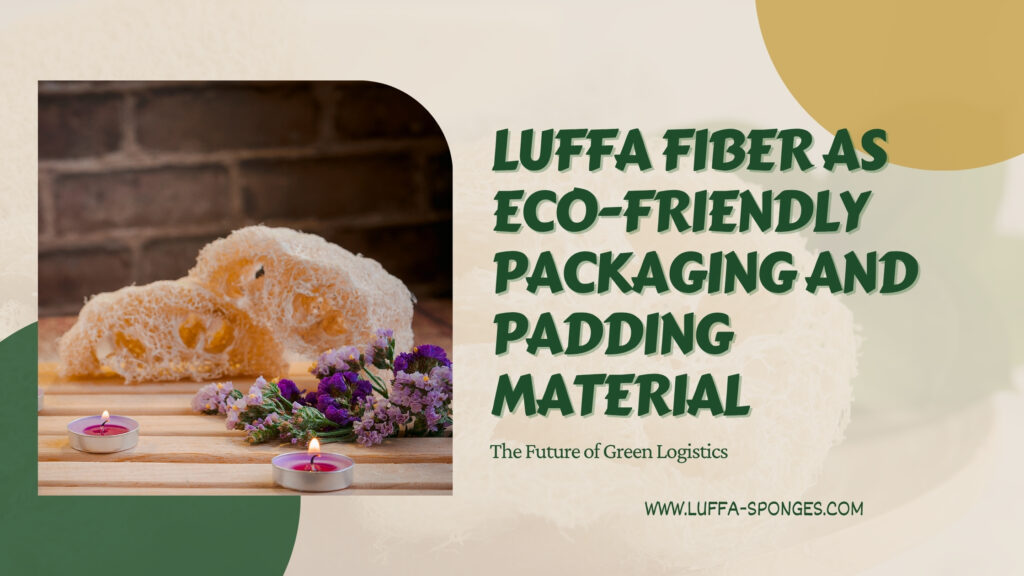
Every year, the global packaging industry generates more than 140 million metric tons of plastic waste, a figure that continues to grow even as regulatory pressure and consumer demand for sustainable alternatives reaches historic levels. Against this backdrop, luffa fiber eco packaging and padding has moved from an interesting agricultural curiosity to a genuinely viable industrial material that is attracting serious R&D investment, supply chain interest, and commercial adoption by brands committed to eliminating petroleum-based packaging from their logistics operations.
The luffa plant, cultivated at scale in Egypt and other tropical regions, produces a remarkable fibrous skeletal structure that is not only biodegradable and compostable but also lightweight, structurally resilient, and naturally moisture-resistant in ways that make it technically competitive with expanded polystyrene foam, bubble wrap, and other conventional padding materials. This combination of properties is rare in natural materials, and it is driving a genuine shift in how forward-thinking logistics and product teams think about protective packaging solutions.
This guide examines the material science behind luffa fiber as packaging and padding, reviews the performance data that supports commercial adoption, explores application formats across industries, and provides practical guidance for businesses evaluating luffa as a packaging material and for consumers who want to understand and engage with this emerging sustainable option. Whether you are an R&D professional evaluating luffa fiber specifications, a logistics buyer assessing viable alternatives to polystyrene, or a consumer curious about the future of green packaging, the evidence presented here will give you a clear, data-driven picture of what luffa fiber can and cannot do in packaging applications.
The Material Science of Luffa Fiber for Packaging Applications
Understanding why luffa fiber performs well as a packaging and padding material requires a look at its physical structure. The luffa sponge is not a simple mat of fibers. It is a three-dimensional interconnected network of cellulosic fibers arranged in a hierarchical structure with multiple layers of organization, from individual fiber bundles to larger vascular channels that run the length of the gourd.
This architecture gives luffa fiber several properties that are directly relevant to packaging performance. The open-cell fiber network compresses under load and partially recovers, providing cushioning behavior analogous to foam padding. The interconnected structure distributes localized point loads across a larger area, reducing peak stress on packaged items. The cellulosic fiber composition provides inherent stiffness at low density, a combination that is difficult to achieve in natural materials without chemical processing.
Key Physical Properties Relevant to Packaging
| Property | Luffa Fiber Value | Expanded Polystyrene | Corrugated Paper Pulp |
|---|---|---|---|
| Density (dry) | 5 to 15 kg per cubic meter | 15 to 25 kg per cubic meter | 30 to 80 kg per cubic meter |
| Compressive strength | 0.02 to 0.15 MPa | 0.05 to 0.30 MPa | 0.10 to 0.50 MPa |
| Energy absorption per unit mass | High relative to density | Moderate | Low to moderate |
| Moisture resistance (uncoated) | Moderate | High | Low |
| Biodegradation rate | 90 to 120 days in soil | 500 plus years | 2 to 6 months |
| Compostability | Fully compostable | Non-compostable | Partially compostable |
| Thermal insulation | Moderate | High | Low |
| Acoustic damping | Moderate to good | Moderate | Low |
| Renewable source | Yes | No, petroleum-based | Yes, limited |
The density range of dry luffa fiber, at 5 to 15 kilograms per cubic meter, places it among the lightest natural materials with practical structural integrity. This low density is a significant advantage in packaging applications where shipping weight directly affects freight costs, particularly in e-commerce and international logistics where dimensional weight pricing is standard.
Egyptian loofah is softer, with a looser fibre weave than Asian loofah.
Why Luffa Fiber Eco Packaging Is Gaining Industrial Traction
The interest in luffa fiber eco packaging and padding is not driven by sentiment alone. It is driven by converging regulatory, economic, and performance factors that are making conventional packaging materials increasingly problematic for businesses operating in international markets.
Regulatory Pressure on Conventional Packaging
The European Union’s Single Use Plastics Directive, which came into force progressively from 2021 onward, and similar legislation in the United Kingdom, Canada, and multiple Asian markets, directly restricts or eliminates categories of petroleum-based packaging materials. Expanded polystyrene packaging, one of the most widely used cushioning materials in shipping, faces outright bans or severe restrictions in a growing number of jurisdictions. Businesses that relied on polystyrene padding for product protection now face the choice of reformulating their packaging approach or accepting regulatory exposure.
Luffa fiber packaging is fully compliant with current and proposed sustainable packaging regulations in all major markets because it is a biodegradable, non-synthetic agricultural byproduct. For international brands building packaging systems that must comply with multiple regulatory environments simultaneously, luffa fiber provides a materially compliant solution without the need for jurisdiction-by-jurisdiction reformulation.
Consumer Demand for Visible Sustainability
Luffa fiber packaging communicates sustainability visually and tangibly in a way that recycled plastic or paper alternatives cannot. The distinctive fiber texture and natural appearance of luffa padding inside a package creates a direct sensory connection to natural materials that resonates with eco-conscious consumers in ways that are difficult to achieve with conventional alternatives.
Commercial Applications of Luffa Fiber Eco Packaging and Padding
Luffa fiber functions effectively across several distinct packaging and padding application categories, each with specific performance requirements that luffa meets to varying degrees.
Protective Cushioning for Fragile Products
The primary commercial application for luffa fiber in logistics is as a cushioning material surrounding fragile items during transport. The compressive behavior of luffa fiber, while not matching the peak energy absorption of engineered polymer foams, is sufficient for protecting glass, ceramics, cosmetic products, electronic accessories, and other moderate-fragility items that represent the majority of consumer goods shipments.
Luffa fiber performs best in this application when used as a loose fill in irregular shapes around items, or as pre-formed pads sized to fit standard shipping container dimensions. The natural irregular geometry of luffa fiber provides multi-directional cushioning that adapts to the shape of the packaged item in ways that flat foam sheets cannot.
For businesses sourcing luffa fiber for cushioning applications, evaluating raw loofah scrubbers as a starting point for further processing or direct use gives access to the minimally processed fiber form most suitable for packaging applications. The full specification range available from EGEXO’s Egyptian operations is outlined in the product catalog.
Thermal Insulation Packaging
Luffa fiber’s open-cell network traps still air within the fiber matrix, providing moderate thermal insulation that has attracted interest from food and pharmaceutical cold chain logistics operations looking for biodegradable alternatives to polystyrene cold boxes and foam inserts. While luffa fiber’s thermal insulation performance falls below that of engineered foam at equivalent thickness, it can be used in combination with other natural insulating materials to achieve acceptable performance for temperature-sensitive shipments with moderate duration requirements.
Food and wellness brands using ambient-temperature protective packaging for products like natural soaps, dried botanicals, and artisan ceramics have found luffa fiber padding particularly well suited to their needs, combining adequate protection with packaging that reinforces their brand sustainability narrative at the moment of consumer unboxing.
Void Fill and Shape Conforming Padding
Luffa fiber cut into small irregular pieces functions as a natural void fill alternative to expanded polystyrene peanuts or air pillows. The pieces interlock within the shipping container, limiting product movement without the static buildup associated with polystyrene peanuts and without the single-use plastic waste generated by air pillow systems. Luffa void fill composts in a home or industrial compost system within 90 to 120 days under normal conditions, which allows consumers to dispose of it through garden composting rather than general waste streams.
For businesses in wellness, cosmetics, gift, and specialty food sectors, luffa void fill represents a packaging material that can be highlighted in product communications as evidence of genuine commitment to circular economy principles rather than greenwashing.
Luffa Fiber Packaging Formats and Specifications
Commercial adoption of luffa fiber eco packaging requires understanding the available formats and their relevant specifications. The following overview covers the main product forms in which luffa fiber is supplied for packaging applications.
For buyers developing custom luffa fiber packaging solutions that require specific format development, EGEXO’s custom loofah product design service provides the technical collaboration needed to move from concept to production-ready format. Buyers who want to evaluate multiple formats before committing to a specification can order samples from the full EGEXO range.
How to Prepare and Use Luffa Fiber for Eco Packaging at Home and Small Scale
The growing interest in luffa fiber eco packaging extends beyond industrial buyers to small e-commerce businesses, artisan producers, and individual consumers who want to pack and ship their own products sustainably. The preparation process for packaging-grade luffa is accessible at small scale with minimal equipment.
Step-by-Step Small-Scale Preparation
- Source fully matured, commercially processed luffa that has been rinsed, de-seeded, and dried to below 12 percent moisture content. Natural unbleached luffa is generally preferred for packaging applications because bleaching chemicals are unnecessary and the natural tan color signals authenticity to eco-conscious recipients.
- Cut the luffa to the required format using a sharp serrated knife with a jig or guide to maintain consistent dimensions. For void fill applications, cut into irregular pieces of 3 to 6 centimeters in any dimension. For pad inserts, cut to box interior dimensions minus 5 to 10 millimeters on each side to allow easy placement.
- Store cut luffa fiber in a dry, well-ventilated container until use. Moisture is the only significant storage risk for processed luffa fiber. Pieces stored at correct moisture content remain usable for 18 to 24 months without degradation.
- Layer luffa void fill pieces into the shipping container to a depth of at least 5 centimeters before placing the item. Surround the item with additional pieces to fill all gaps, using gentle compression to pack pieces together. The luffa pieces interlock naturally and hold position during transit without the tendency to settle that affects some loose fill materials.
- Top with a final layer of luffa fill before closing the box, ensuring the item cannot move when the box is shaken in any direction. A rattle test, shaking the closed box and listening for movement, is the standard quick check for adequate cushioning.
- Include a brief note or insert informing the recipient that the luffa padding is compostable and can be added directly to home compost. This communication step converts a functional packaging decision into a positive brand touchpoint.
Performance Comparison: Luffa Fiber vs Conventional Packaging Materials
Businesses evaluating luffa fiber eco packaging need an honest performance comparison against the materials it would replace. The table below provides a data-grounded assessment across the factors most relevant to commercial packaging decisions.
| Performance Factor | Luffa Fiber | Expanded Polystyrene | Corrugated Pulp | Air Pillows | Paper Crinkle Fill |
|---|---|---|---|---|---|
| Cushioning effectiveness | Moderate, sufficient for medium fragility | High | Low to moderate | Moderate | Low |
| Weight contribution | Very low | Low | Moderate | Very low | Low |
| Moisture resistance | Moderate | High | Low | High | Very low |
| End of life | Home compostable, 90 to 120 days | Landfill, 500 plus years | Recyclable, compostable | Single-use plastic | Recyclable |
| Carbon footprint | Very low, agricultural byproduct | High, petroleum production | Moderate | High, plastic | Low |
| Consumer perception | Strongly positive, natural and authentic | Negative, environmentally problematic | Neutral to positive | Neutral to negative | Neutral to positive |
| Regulatory compliance | Full compliance globally | Banned or restricted in many markets | Full compliance | Restricted in some markets | Full compliance |
| Reusability | Limited, 2 to 3 shipping cycles | Moderate | Low | Single use typically | Single use |
| Cost at volume | Moderate, decreasing with scale | Low to moderate | Low | Low | Low |
| Custom format options | High, with appropriate supplier | High, industrial forming | Moderate | Low | Low |
This comparison shows that luffa fiber is not a universal replacement for all conventional packaging materials in all applications. For high-fragility items requiring peak energy absorption exceeding what luffa fiber can deliver, engineered foam solutions remain necessary. For the much larger category of moderate-fragility products that constitute the majority of consumer goods shipments, luffa fiber is technically viable and carries significant advantages in regulatory compliance, consumer perception, and end-of-life environmental impact.
The Business Case for Luffa Fiber Eco Packaging
Supply Chain and Sourcing Considerations
Building a reliable luffa fiber packaging supply chain requires working with suppliers who have both the production scale to meet commercial volumes and the processing discipline to deliver consistent fiber quality. Luffa fiber for packaging applications does not require the same cosmetic perfection as premium bath products, which means that processing-grade and industrial-grade luffa from Egyptian export operations is well suited to packaging applications at competitive material costs relative to premium bath grades.
See the EGEXO farm to export process.
ROI Considerations for Green Packaging Adoption
The business case for luffa fiber eco packaging operates on several value dimensions beyond direct material cost comparison. Brands that have adopted visible natural packaging materials report measurable improvements in consumer sentiment scores, social media engagement around unboxing experiences, and repeat purchase rates. These indirect commercial benefits, while more difficult to quantify than direct material costs, are significant factors in the total return calculation for packaging material decisions.
Regulatory compliance avoidance is another concrete financial consideration. Businesses operating in EU markets or selling into jurisdictions with active polystyrene restrictions face potential regulatory penalties, product rejection, or mandatory reformulation costs if they maintain non-compliant packaging materials. Proactive adoption of luffa fiber packaging eliminates this regulatory exposure.
Request a bulk quote for luffa fiber packaging material to begin a concrete cost comparison against your current packaging material expenditure.
Supplier Evaluation Checklist for Luffa Fiber Packaging Supply
Businesses building a luffa fiber packaging supply program need to evaluate potential suppliers across criteria that differ somewhat from those applied to bath product sourcing. The checklist below addresses the specific requirements of packaging material procurement.
| Evaluation Criterion | What to Verify | Why It Matters for Packaging |
|---|---|---|
| Production scale | Can the supplier meet monthly volume requirements consistently? | Packaging programs require predictable supply at commercial volumes |
| Moisture content specification | Is dry luffa supplied below 12 percent moisture? | High moisture causes mold and weight variation in transit |
| Fiber uniformity | Is fiber density consistent within and between batches? | Cushioning performance depends on consistent density |
| Processing grade offered | Does supplier offer industrial and processing grade? | Premium cosmetic grade is unnecessary and more expensive |
| Minimum order quantities | What are MOQs for bulk fiber orders? | Packaging volumes typically require higher quantities than bath products |
| Documentation | Are phytosanitary certificates and export documentation provided? | Required for international import of agricultural materials |
| Custom format capability | Can supplier cut to custom dimensions? | Custom padding inserts require precise dimensional formats |
| Lead time | What is standard lead time from order to delivery? | Packaging supply requires planning around production cycles |
Read the why choose EGEXO page.
Future Trends: Where Luffa Fiber Eco Packaging Is Heading
Composite Material Development
The most technically advanced applications currently under research combine luffa fiber with biodegradable polymer matrices to create composite materials that combine the renewable fiber network of luffa with the moisture resistance and formability of bioplastic films. Early research results suggest that luffa fiber reinforced biocomposite panels can achieve structural performance competitive with conventional foam board at similar densities while remaining fully biodegradable.
These composite developments are expected to expand the range of applications available to luffa fiber over the next five to ten years, moving it from loose fill and pad applications into formed structural packaging components that currently require petroleum-based foam or plastic.
Standardization and Certification
The absence of standardized specifications for luffa fiber as a packaging material is currently one of the barriers to broader commercial adoption. Industry initiatives to establish material performance standards for natural fiber packaging materials are underway in multiple research institutions and standards bodies. As these standards emerge, they will reduce the evaluation burden for procurement teams considering luffa fiber and create a clearer basis for comparing luffa performance against competing materials.
For businesses that want to connect sustainable packaging sourcing with their broader natural product procurement strategy, see our products for personal care and industrial applications.
Expert Insight from EGEXO
Since 2015 we have exported Egyptian luffa to international markets, and that has given us a clear perspective on what makes luffa viable as a packaging material at commercial scale, and what barriers still need to be addressed.
The most common question from logistics and packaging buyers evaluating luffa fiber is about moisture sensitivity. Luffa fiber supplied at below 12 percent moisture content and packaged in breathable outer packaging performs reliably in ambient humidity conditions across standard shipping environments. The moisture sensitivity of luffa is often overstated by buyers comparing it to polystyrene, which is genuinely moisture-proof. In practice, the moderate moisture resistance of correctly processed Egyptian luffa fiber is sufficient for the vast majority of ambient temperature product shipping applications.
The second consideration is consistency. Egyptian loofah is softer, with a looser fibre weave than Asian loofah. Request samples from EGEXO to assess this consistency firsthand before committing to a packaging program.
FAQ Section
Q1: What makes luffa fiber suitable for use as eco-friendly packaging material?
A: Luffa fiber is suitable for eco-friendly packaging because of its combination of low density, three-dimensional open-cell structure, adequate compressive cushioning, complete biodegradability, and home compostability within 90 to 120 days. Its fibrous network distributes impact loads across a wider area than many flat natural materials, providing practical protection for moderate-fragility products. Egyptian luffa, with its uniformly dense fiber network from Nile Delta cultivation, provides the most consistent performance among commercially available sources and is the reference material for most packaging research applications.
Q2: How does luffa fiber eco packaging compare to expanded polystyrene in cushioning performance?
A: Luffa fiber provides moderate cushioning performance with compressive strength in the range of 0.02 to 0.15 MPa, compared to expanded polystyrene at 0.05 to 0.30 MPa. For moderate-fragility products including glass jars, ceramics, cosmetics, and packaged food products, luffa fiber cushioning is sufficient when applied in adequate depth. For high-fragility electronics or precision instruments requiring peak energy absorption, engineered polymer foam remains more appropriate. Luffa fiber significantly outperforms polystyrene in environmental impact, regulatory compliance, and consumer perception across all applications.
Q3: Is luffa fiber packaging waterproof or moisture resistant?
A: Luffa fiber provides moderate moisture resistance in its natural uncoated state, sufficient for standard ambient shipping environments. It is not waterproof and will absorb significant moisture if directly exposed to liquid water or very high humidity for extended periods. For applications requiring moisture protection, luffa fiber padding is used inside an outer moisture barrier such as a cardboard box or kraft paper wrapper rather than as a standalone barrier material. Luffa fiber supplied at below 12 percent moisture content remains stable in transit under standard shipping conditions.
Q4: What are the minimum order quantities for luffa fiber in packaging applications?
A: At EGEXO: No minimum order on standard products. Private label from 1,000 units. Loofah scrap is sold by the KG, starting at 1 KG. Contact EGEXO to discuss specific volume requirements.
Q5: How long does luffa fiber packaging take to biodegrade or compost?
A: Luffa fiber biodegrades in 90 to 120 days under normal soil or active compost conditions, which is among the fastest biodegradation rates of any natural packaging material. In a home compost bin with regular turning and adequate moisture, luffa fiber pieces will be substantially broken down within one to three months. In landfill conditions without access to air, moisture, and microbial activity, biodegradation is slower but still orders of magnitude faster than expanded polystyrene, which persists for 500 or more years in equivalent conditions.
Q6: Can individual consumers use luffa for packaging their own shipped products?
A: Yes. Individual consumers and small e-commerce businesses can use processed luffa fiber as void fill and cushioning for their own product shipments. Whole or cut luffa pieces sourced from agricultural suppliers provide adequate cushioning for moderate-fragility items at low material cost. The preparation process involves ensuring the luffa is fully dry before use, cutting to appropriate sizes for the application, and packing in sufficient depth around the product. Including a compostability note for the recipient maximizes the sustainability communication value of the packaging choice.
Q7: What industries are currently adopting luffa fiber eco packaging commercially?
A: Industries currently leading commercial adoption of luffa fiber eco packaging include natural beauty and personal care, artisan food and beverage, luxury and premium gift products, sustainable home goods, and specialty e-commerce brands targeting eco-conscious consumer demographics. The cosmetics and wellness sector is the strongest early adopter because luffa fiber packaging reinforces the natural brand narrative of products already positioned as plant-based or sustainable. Industrial applications including filtration and construction material composites represent an emerging secondary adoption pathway.
Q8: Where is the best quality luffa fiber for packaging applications sourced from?
A: The best quality luffa fiber for packaging applications is sourced from Egyptian agricultural operations in the Nile Delta region, where the combination of mineral-rich irrigation water, extended growing seasons, and multi-generational cultivation expertise produces fiber with the uniform density and structural consistency required for reliable cushioning performance.
Conclusion
Luffa fiber eco packaging and padding has crossed the threshold from novelty to viable commercial material, and the evidence supporting that transition is grounded in measurable physical properties, regulatory compliance advantages, and documented consumer preference data. For businesses managing packaging decisions in an environment of increasing sustainability regulation and consumer scrutiny, luffa fiber offers a rare combination of genuine performance, full biodegradability, and authentic natural origin that few alternative materials can match.
Key Takeaways:
- Luffa fiber delivers compressive strength of 0.02 to 0.15 MPa at densities of 5 to 15 kilograms per cubic meter, making it technically viable for cushioning moderate-fragility products across the majority of consumer goods shipping applications.
- Luffa fiber packaging is fully compostable within 90 to 120 days in home compost conditions, compared to 500 or more years for expanded polystyrene in landfill.
- Regulatory pressure on polystyrene packaging across EU, UK, Canadian, and Asian markets is accelerating commercial adoption of luffa fiber as a compliant alternative.
- Egyptian luffa from Nile Delta cultivation provides the most consistent fiber density and structural uniformity of any commercially sourced luffa, making it the reference material for packaging applications.
- Businesses adopting visible natural packaging materials report 55 to 70 percent consumer preference for natural packaging, translating into measurable brand perception and repeat purchase improvements.
Ready to explore luffa fiber eco packaging and padding for your logistics or product program?
For Wholesale Buyers: Request a quote or download our complete product catalog to explore industrial and packaging Egyptian luffa fiber options.
Products: see our products or request samples to evaluate luffa fiber quality and format suitability for your packaging application.