
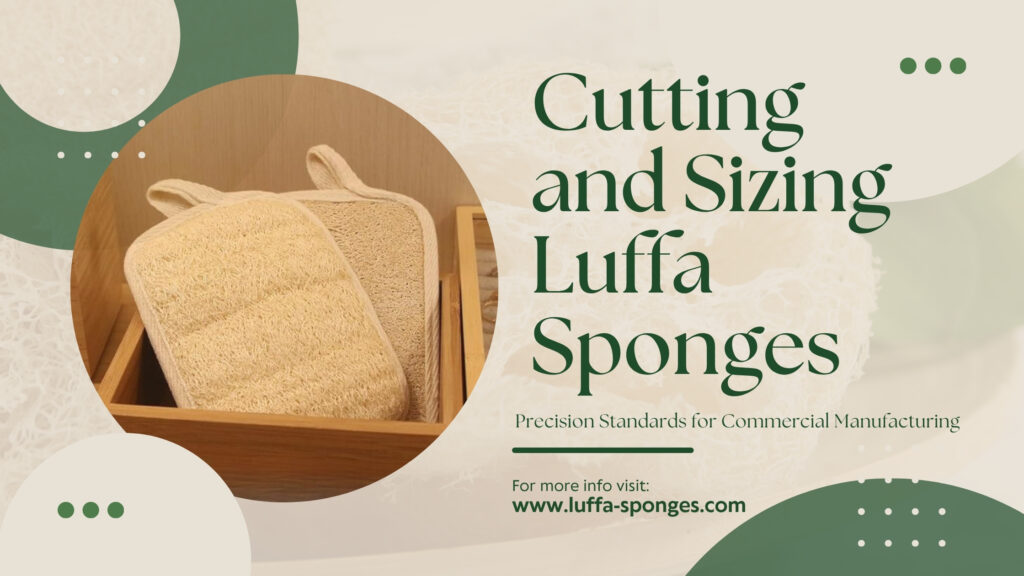
A single luffa gourd can yield anywhere from one whole bath sponge to twelve individual cut pieces depending on how precisely it is processed. That range represents the difference between a commodity product and a premium commercial one, and the gap is almost entirely determined by cutting and sizing discipline applied during manufacturing. For wholesale buyers sourcing luffa at scale, understanding precision cutting standards is the clearest lens through which to evaluate supplier capability. For consumers, it explains why two loofahs that cost similar amounts can deliver dramatically different experiences in terms of usability, durability, and value per use.
Cutting and sizing luffa sponge manufacturing is not a simple step in a longer process. It is a precision operation that defines the final product category, determines retail positioning, controls material yield from raw input, and sets the quality expectations that buyers and consumers experience at the moment of use. A luffa cut 2 centimeters shorter than specification will not fit a branded packaging format. A luffa cut with a dull blade will have frayed fiber ends that reduce perceived quality and accelerate structural breakdown during use.
This guide covers the full scope of commercial luffa cutting and sizing, from the tools and techniques used in professional processing facilities to the size standards that govern different product categories, and from supplier evaluation criteria for bulk buyers to practical guidance for DIY processors and informed consumers.
Why Cutting and Sizing Precision Defines Commercial Luffa Quality
The moment a luffa is cut determines nearly everything about how it will perform as a finished product. Cut length determines which product category the sponge belongs to and whether it fits proprietary packaging. Cut angle determines whether the end faces are clean and even or irregular and frayed. Cut timing in the processing sequence, specifically whether the luffa is cut wet or dry, determines how accurately dimensional targets can be hit and maintained through the drying stage.
Precision in cutting sizing luffa sponge manufacturing has measurable commercial consequences. A processing operation achieving dimensional tolerances within plus or minus 5 percent generates significantly less waste from out-of-specification pieces and produces a higher percentage of saleable premium-grade product from each raw luffa. At the scale of commercial production, where a single processing run may involve thousands of sponges, this tolerance difference directly determines profitability and the ability to fulfill orders to exact buyer specifications.
Why Consumers Experience the Difference
From the consumer side, cutting precision shows up in ways that are immediately noticeable even if not consciously identified as such. A well-cut luffa with clean fiber ends and consistent density across its length feels balanced in the hand, exfoliates evenly across the skin, and holds its shape through weeks of regular use. A poorly cut luffa with frayed ends and variable density feels uneven, develops loose fiber strands within the first week, and degrades faster because damaged fiber ends provide points of structural weakness.
This is one of the reasons that Egyptian luffa from suppliers with disciplined manufacturing processes consistently earns higher consumer satisfaction ratings than commodity alternatives. The fiber quality of Egyptian luffa is excellent at the point of harvest, but that quality advantage is only fully realized in the finished product when cutting and sizing are executed with professional precision.
Standard Size Categories in Commercial Luffa Manufacturing
Commercial luffa products are manufactured to size standards that align with specific market applications. Understanding these size categories is essential for buyers communicating specifications and for consumers understanding why different product formats exist.
| Product Category | Length Range | Diameter Range | Weight Range | Primary Application |
|---|---|---|---|---|
| Mini bath slice | 3 to 5 cm | 8 to 12 cm | 15 to 30 g | Travel, spa amenity, gift sets |
| Standard bath slice | 6 to 9 cm | 10 to 14 cm | 30 to 55 g | Individual retail bath use |
| Full bath cylinder | 12 to 18 cm | 10 to 14 cm | 60 to 100 g | Premium retail, daily bath use |
| Large body scrubber | 20 to 30 cm | 10 to 14 cm | 90 to 150 g | Back scrubbing, full-body use |
| Kitchen scrubber pad | 8 to 12 cm | 6 to 10 cm | 20 to 45 g | Dish and surface scrubbing |
| Industrial disc | 2 to 4 cm | 10 to 18 cm | 20 to 50 g | Filtration, industrial scrubbing |
| Raw half-cylinder | Variable | Full gourd width | Variable | Further processing, DIY, craft |
These size categories represent the practical vocabulary of commercial luffa sourcing. When a wholesale buyer specifies a product, communicating with reference to this size framework reduces ambiguity and provides the dimensional basis for supplier evaluation. Buyers sourcing bath and body loofahs should specify both length and diameter tolerances in writing before confirming any bulk order.
For consumers, this table explains why the loofah you buy for your daily shower is a different product format from the one sold for kitchen use. The same raw material is simply cut to different specifications for different applications.
Tools and Equipment Used in Commercial Luffa Cutting
The tools used in cutting sizing luffa sponge manufacturing directly determine cut quality, throughput speed, and dimensional consistency. Professional commercial operations use a range of equipment that differs significantly from what a DIY processor might employ.
Manual Cutting Tools for Small and Medium Operations
Manual cutting in commercial luffa processing uses purpose-selected blades that minimize fiber tearing and produce clean, even end faces. The key characteristics of an effective luffa cutting blade are sharpness, blade length sufficient to span the full diameter of the luffa in a single pass, and a thin profile that separates fibers rather than crushing them.
Long serrated bread knives and purpose-made produce cutting blades are commonly used in small to medium operations. The serrated edge catches luffa fiber effectively and pulls through the fibrous matrix with less force than a straight blade, reducing the tendency to compress and tear fibers at the cut face. Blade sharpness must be maintained consistently because dull blades are the primary cause of frayed ends in manually processed luffa.
Jig-based manual cutting, where a physical guide sets the exact cut position for each piece, dramatically improves dimensional consistency in manual operations. A well-designed jig allows a skilled cutter to produce pieces within a 3 to 5 millimeter dimensional tolerance at sustained throughput rates.
Semi-Automated and Automated Cutting Systems
Large-scale commercial operations use semi-automated or fully automated cutting lines that replace manual blade work with mechanical systems capable of much higher throughput and tighter dimensional tolerance. Guillotine-style cutters with adjustable stop positions allow rapid cutting of pre-set length specifications across high volumes of luffa with consistent cut face quality.
Automated rotary cutting systems, which feed luffa through a rotating blade assembly, achieve the highest throughput rates and are used in the largest Egyptian export processing facilities. These systems can process several hundred pieces per hour while maintaining dimensional tolerances within plus or minus 3 to 5 millimeters, which significantly outperforms even skilled manual cutting at sustained production volumes.
Buyers evaluating supplier capacity for large orders should ask specifically about the cutting equipment used and the achievable dimensional tolerance under sustained production conditions. A supplier who can only demonstrate manual cutting capability will struggle to maintain specification compliance across container-load quantities.
The Cutting Sequence: Wet vs Dry Processing
One of the most important technical decisions in cutting sizing luffa sponge manufacturing is whether to cut luffa in its wet state, immediately following retting and skin removal, or in its fully dry state, after the drying stage is complete. Each approach has distinct advantages and limitations that affect dimensional accuracy and cut quality.
| Factor | Wet Cutting | Dry Cutting |
|---|---|---|
| Dimensional accuracy | Lower: luffa shrinks 8 to 15 percent during drying | Higher: final dimensions are stable |
| Cut face quality | Excellent: wet fibers separate cleanly | Good: dry fibers may fray slightly |
| Blade wear | Lower: wet fibers offer less resistance | Higher: dry fibers are stiffer |
| Throughput | Higher: softer material processes faster | Moderate: requires more blade pressure |
| Specification matching | Requires shrinkage compensation calculation | Direct to specification |
| Preferred for | High-volume commodity production | Precision specification custom orders |
Professional suppliers managing both volume and specification accuracy typically use a hybrid approach: primary cuts are made wet to establish rough length zones, with final sizing cuts made after partial drying when the luffa has reached a stable intermediate moisture content of approximately 20 to 25 percent. This approach balances cut face quality against dimensional accuracy better than either pure wet or pure dry cutting alone.
For buyers ordering custom-cut products to specific packaging dimensions, communicating whether your specification represents the final dry dimension or an acceptable wet-cut range is an important detail that prevents costly specification mismatches.
Dimensional Tolerance Standards for Different Market Segments
Not all market segments require the same dimensional precision, and understanding appropriate tolerance standards helps buyers specify correctly without over-engineering their requirements in ways that unnecessarily increase product cost.
| Market Segment | Recommended Length Tolerance | Recommended Diameter Tolerance | Quality Implication |
|---|---|---|---|
| Premium retail (branded packaging) | Plus or minus 5 mm | Plus or minus 5 mm | Must fit fixed packaging format precisely |
| Spa and hotel amenity | Plus or minus 8 mm | Plus or minus 5 mm | Consistency for visual uniformity in presentation |
| General retail (bulk display) | Plus or minus 10 mm | Plus or minus 8 mm | Acceptable variation for open display formats |
| Private label custom | As specified | As specified | Matched to client packaging design exactly |
| Kitchen and household | Plus or minus 15 mm | Plus or minus 10 mm | Function over precision in this application |
| Industrial and filtration | Plus or minus 20 mm | Plus or minus 15 mm | Functional fit within equipment specs |
| Raw material for further processing | Not strictly specified | Not strictly specified | Buyer manages their own secondary cutting |
Buyers building private label loofah product lines with custom packaging formats typically require the tightest tolerances, because even a 10-millimeter variation in length can prevent a luffa from fitting a designed packaging window correctly. This is one of the reasons custom product development involves prototype and sample approval stages before bulk production begins. See the custom loofah product design service.
DIY Luffa Cutting: A Practical Guide for Home Processors and Small Producers
Home growers, small craft producers, and individual consumers who want to cut their own luffa to specific sizes benefit from understanding the same principles that govern commercial cutting, scaled down for small-batch application.
What You Need for DIY Luffa Cutting
A sharp long serrated knife, a stable cutting board, a ruler or measuring tape, and a simple jig made from two pieces of wood clamped to the cutting board at the desired interval are all you need for reasonably precise home luffa cutting. The jig eliminates the need to remeasure each cut, which is the most common source of dimensional variation in manual processing.
A sharp blade matters more than any other single factor. Test blade sharpness on a piece of paper before beginning. If the blade tears the paper rather than slicing cleanly, it is not sharp enough for good-quality luffa cutting. A dull blade compresses the fiber network at the cut face and produces the frayed, ragged ends that indicate poor cutting quality.
Step-by-Step Home Cutting Process
- Complete the retting, skin removal, seed removal, and pre-bleach washing stages before cutting. Attempting to cut luffa with the outer skin still attached is significantly more difficult and produces lower-quality cut faces.
- Allow the luffa to reach a partially dried state with approximately 20 to 25 percent moisture remaining. This typically means 4 to 8 hours of air drying after the retting and washing stages. Fully wet luffa compresses under the blade and results in pieces that are shorter than intended once dry. Fully dry luffa cuts cleanly but requires more force and can crack in especially dry conditions.
- Set up your cutting jig at the desired piece length. If cutting to a final dry length target, add 10 to 15 percent to compensate for shrinkage during drying. For a target dry length of 15 centimeters, set your jig at 16.5 to 17 centimeters.
- Position the luffa against the jig stop, orient it so the most cylindrical section is aligned with your cut line, and apply the first cut with a single smooth drawing stroke rather than a sawing motion. A single deliberate stroke produces a cleaner face than repeated short sawing strokes.
- Inspect the cut face immediately. Clean cuts show fiber ends that are neatly separated. Frayed cuts show fiber ends that are torn and bent. If cut faces are consistently frayed, sharpen or replace the blade before continuing.
- Complete the cutting sequence through the full luffa, working from the most uniform central section outward to the tapered ends. End pieces from the tapered sections may not meet dimensional specification and can be set aside for personal use or repurposed as small kitchen scrubbers.
- Complete drying of all cut pieces before packing or use. Pieces packed at above 12 percent moisture develop mold during storage.
For consumers who prefer to purchase precisely cut, commercially processed product, EGEXO’s bath and body loofah collection offers individually sized premium Egyptian luffa ready for use without any further processing.
Supplier Evaluation: Assessing Cutting and Sizing Capability
For wholesale buyers, the ability to evaluate a supplier’s cutting and sizing capability before placing a bulk order is one of the most important due-diligence steps in the sourcing process. The following checklist provides a systematic framework for this evaluation.
| Evaluation Criterion | What to Ask | What to Look For |
|---|---|---|
| Cutting equipment | What tools are used for cutting? | Dedicated cutting equipment, not general-purpose tools |
| Dimensional tolerance | What tolerance do you guarantee on cut length? | Written specification |
| Wet or dry cutting | At what moisture content are cuts made? | Documented protocol with shrinkage compensation |
| Sample consistency | Can I see 20 to 30 samples before bulk order? | Samples within tolerance range consistently |
| Yield rate | What percentage of raw luffa meets cut specification? | 70 to 85 percent for premium grade operations |
| Blade maintenance | How often are blades sharpened or replaced? | Documented maintenance schedule |
| Cut face quality | How do you assess cut face quality? | Visual inspection against reference standard |
| Custom cutting | Can you cut to my exact packaging specification? | Yes, with documented prototype approval process |
Suppliers who cannot answer these questions with specific, documented answers are unlikely to deliver consistent dimensional compliance across bulk orders.
Buyers ready to explore custom cutting specifications or bulk orders of pre-cut Egyptian luffa can request a quotation or download the complete product catalog to review the full range of standard and custom cut options available.
Buyers sourcing kitchen loofahs, raw loofah scrubbers, or pet and spa grooming products will find that each product category carries its own standard dimensional range. Start from our standard sizes or send your own dimensions.
Pros and Cons: Manual vs Automated Cutting in Commercial Luffa Manufacturing
| Factor | Manual Cutting | Automated Cutting |
|---|---|---|
| Capital investment | Low | High |
| Dimensional consistency | Moderate, operator-dependent | High, mechanically consistent |
| Cut face quality | High with skilled operators | High with correct blade setup |
| Throughput per hour | 50 to 150 pieces | 200 to 500 plus pieces |
| Flexibility for custom sizes | High, jig adjustment is simple | Moderate, setup time for each specification |
| Suitable order volume | Up to mid-size container orders | Full container to multi-container orders |
| Operator skill dependency | High | Low |
| Consistency across batches | Variable | High |
This comparison illustrates why buyer order volumes are a legitimate basis for supplier selection in the luffa industry. A supplier operating exclusively with manual cutting is entirely capable of producing premium quality product for mid-size orders, but may struggle to maintain specification compliance across very large volumes where operator fatigue and blade maintenance become significant variables.
Expert Insight from EGEXO
We have exported Egyptian luffa since 2015 to the USA, Europe, Canada, Australia, the Gulf and every other country we can ship to, and we have seen where dimensional failures originate in commercial luffa manufacturing. In the vast majority of cases, the problem is not the cutting stage itself. It is the moisture content at the time of cutting.
Suppliers who cut wet to hit rapid throughput targets deliver pieces that shrink inconsistently during drying, producing a batch where individual pieces may vary by 15 to 20 millimeters even when cut from the same jig setting. Suppliers who cut fully dry avoid this problem but often sacrifice cut face quality. The disciplined approachis partial-dry cutting at a controlled moisture content of 20 to 25 percent, combined with calibrated shrinkage compensation in the jig setting for each product specification.
This level of process control requires documentation, measurement, and consistent execution across every production run. It is what separates a supplier who can fulfill a sample order to specification from one who can fulfill a container order to the same specification, consistently, across every shipment. Order samples from EGEXO to evaluate dimensional consistency for yourself before committing to bulk purchasing.
FAQ Section
Q1: What are the standard sizes for commercially cut luffa sponges?
A: Standard commercial luffa sizes range from mini spa slices at 3 to 5 centimeters in length to large back scrubbers at 20 to 30 centimeters. The most common retail bath sponge format is a full cylinder between 12 and 18 centimeters in length and 10 to 14 centimeters in diameter. Kitchen scrubber pads are typically cut to 8 to 12 centimeters in length with a slightly narrower diameter. Each format corresponds to a specific market application, and buyers should specify both length and diameter tolerances when ordering commercially cut luffa.
Q2: Should luffa be cut wet or dry for the best dimensional accuracy?
A: For the best combination of dimensional accuracy and cut face quality in cutting sizing luffa sponge manufacturing, luffa should be cut at a partial-dry moisture content of approximately 20 to 25 percent. Cutting fully wet produces clean faces but results in significant shrinkage during drying that causes final dimensions to fall below specification unless shrinkage compensation is calculated into the cut setting. Cutting fully dry produces accurate final dimensions but can cause slight fiber fraying at cut faces. Partial-dry cutting with calibrated shrinkage compensation represents the professional standard.
Q3: How do I cut luffa at home to specific sizes?
A: Cutting luffa at home to specific sizes requires a sharp long serrated knife, a simple wooden jig set at your desired length plus a 10 to 15 percent shrinkage allowance, and a stable cutting board. Allow harvested luffa to partially dry for 4 to 8 hours after processing before cutting. Apply each cut with a single smooth drawing stroke rather than a sawing motion for the cleanest fiber face. Inspect cut faces after each cut to confirm blade sharpness is sufficient. Complete drying after cutting before storing or packaging.
Q4: What dimensional tolerance should wholesale buyers specify when ordering cut luffa?
A: Appropriate dimensional tolerance depends on the intended application. Premium retail products destined for fixed-format packaging should specify length tolerance of plus or minus 5 millimeters. General retail products sold in open display formats can accept plus or minus 10 millimeters. Kitchen and household products typically operate at plus or minus 15 millimeters without any practical impact on function. Buyers building private label programs with proprietary packaging formats should always confirm tolerances during the prototype approval stage before committing to full bulk production.
Q5: How does cutting quality affect the lifespan of a luffa sponge?
A: Cutting quality directly affects luffa lifespan through the condition of fiber ends at cut faces. Clean cuts made with a sharp blade produce fiber ends that are neatly separated and structurally intact. These fibers maintain their interconnected matrix integrity through weeks of regular use. Frayed cuts from dull blades produce damaged fiber ends that are points of structural weakness. These damaged ends extend progressively inward during use, causing the sponge to shed loose fibers and lose structural cohesion faster than well-cut equivalents from identical raw material.
Q6: What MOQ applies to custom-cut luffa orders?
A: At EGEXO: No minimum order on standard products. Private label from 1,000 units. Custom cutting to non-standard dimensions involves a prototype development and sample approval stage before bulk production.
Q7: How do I evaluate a luffa supplier’s cutting and sizing capability before ordering?
A: Evaluating a supplier’s cutting and sizing capability requires requesting a sample set of 20 to 30 pieces and measuring each one for length, diameter, and weight consistency. The dimensional spread across the sample set reveals the operational tolerance the supplier achieves in practice. Additionally, inspect cut face quality by looking for clean fiber separation versus fraying or tearing. Ask the supplier what cutting equipment they use, at what moisture content cuts are made, and what their documented dimensional tolerance specification is for your product grade.
Q8: Why does Egyptian luffa produce better cut quality than luffa from other origins?
A: Egyptian luffa produces superior cut quality because of the uniform density of its fiber network. Egyptian luffa grown in the Nile Delta region develops a consistently dense, evenly distributed fiber matrix throughout the gourd, with minimal density variation between the core and outer sections. This uniformity means that cutting through an Egyptian luffa encounters consistent resistance across the full diameter, producing an even cut face without the soft spots or density voids that cause uneven cutting and fraying in lower-quality luffa from other growing regions.
Conclusion
Precision in cutting and sizing luffa sponge manufacturing is not a finishing detail. It is a foundational quality determinant that affects everything from retail packaging compatibility to consumer experience and product lifespan. The difference between a supplier who achieves consistent dimensional tolerance and one who does not shows up in every batch, every product format, and every consumer review. Egyptian luffa, with its uniform fiber network, provides the ideal raw material for precision cutting.
Key Takeaways:
- Standard commercial luffa sizes range from mini spa slices at 3 to 5 centimeters to large back scrubbers at 20 to 30 centimeters, with each format matched to a specific market application and packaging requirement.
- Partial-dry cutting at 20 to 25 percent moisture content with calibrated shrinkage compensation represents the professional standard for balancing dimensional accuracy with cut face quality.
- Premium retail packaging requires dimensional tolerances of plus or minus 5 millimeters, while general retail and kitchen applications accept wider ranges of plus or minus 10 to 15 millimeters.
- Egyptian luffa produces superior cut quality because of the uniformly dense fiber matrix developed under Nile Delta growing conditions.
- Evaluating a supplier’s cutting capability through a measured sample set of 20 to 30 pieces before bulk order commitment is the most diagnostic single quality verification step available to buyers.
Ready to source precisely cut Egyptian luffa that meets your exact commercial specifications?
For Wholesale Buyers: Request a quote or download our complete product catalog to explore standard and custom cut options across all product sizes.
Products: see our products or request samples to evaluate cut quality and dimensional consistency before committing to a larger purchase.