
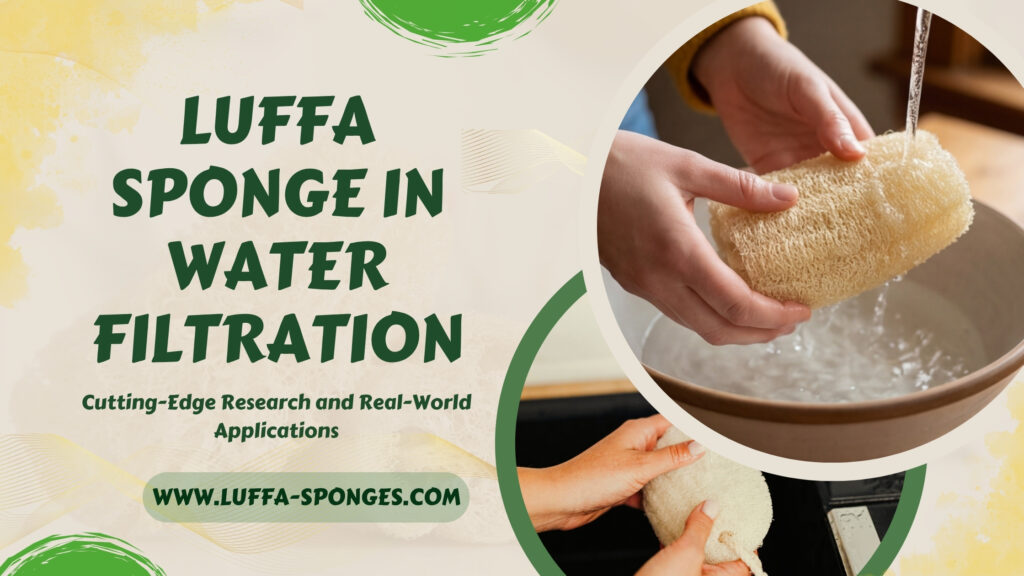
A dried gourd fibre that can act as a low-cost, biodegradable filter medium is not a curiosity. Luffa sponge has a natural open network of fibres that makes it interesting for water filtration, from industrial pretreatment to simple home and garden uses.
For environmental engineers and R&D teams, luffa offers a chemically modifiable, mechanically resilient, fully biodegradable filtration platform. For wholesale buyers and product developers, the same material is the raw luffa fiber your customers already trust for bath and kitchen applications, with an industrial dimension. For eco-conscious consumers, luffa also has simple, practical uses around the home and garden.
This article covers luffa sponge water filtration, from the material properties that make it useful as a filter to practical use, scale-up considerations, and how sourcing quality affects results.
The Material Behind Luffa Sponge Water Filtration
Understanding why luffa works as a filtration medium is essential. The performance does not come from any single property. It emerges from a combination of structural, chemical, and physical characteristics.
Pore Architecture and Surface Area
Luffa sponge is a naturally open-cell reticular network derived from the dried vascular structure of the Luffa aegyptiaca plant. Its pores are interconnected. This architecture creates a depth filtration effect rather than simple surface filtration, trapping particles at multiple layers as fluid passes through the material.
The internal surface area accessible to fluids is much larger than the external dimensions suggest, which helps the fibre hold on to particles in the water.
Cellulose Surface Chemistry and Reactive Sites
Luffa fiber is made mainly of cellulose, with hemicellulose and lignin making up the rest. Cellulose chains present hydroxyl groups on their surfaces, which give the fibre a chemically active surface.
Buying luffa for a shop or project? See the EGEXO catalog for our natural loofah products.
Practical Use of Luffa in Water Filtration
Luffa is a promising natural filter material, and several factors support its practical use.
Factors Supporting Practical Scale-Up
Luffa grows as an annual agricultural crop with established cultivation practices across multiple tropical and subtropical regions. Egyptian production is concentrated in the Nile Delta. This agricultural scalability means raw material availability is not the limiting factor for luffa filtration technology commercialization.
Good-quality luffa recovers its shape after compression, which supports use in flowing-water systems where filter media must withstand pressure over time.
Understanding the full agricultural and processing chain behind your luffa source directly affects the reliability of your filtration development outcomes. See the EGEXO farm-to-export process.
Industrial buyers needing bulk raw luffa for filtration use can request a quotation directly from EGEXO, or order samples to evaluate material quality before full purchasing commitment.
Quality Specifications for Luffa Used in Filtration
Not all luffa material performs equally in water filtration applications. Fiber density, chemical composition, processing method, and harvest maturity all influence filtration performance.
Step-by-Step Luffa Quality Evaluation for Filtration Use
- Assess fiber density by comparing dry weight per unit volume across multiple samples from the same batch. Consistent density indicates uniform harvest maturity and processing, both critical for reproducible adsorption capacity.
- Perform a compression recovery test by compressing the sponge to half its thickness and releasing. Good luffa should spring back close to its original thickness within a few seconds.
- Inspect pore structure visually and by water flow-through test. Hold the sponge up to light and confirm visible open porosity throughout the structure. Then pour water through and confirm it flows freely with no pooling or channeling.
- Check for chemical treatment indicators. Over-bleached luffa has a uniformly bright white appearance and a faint chemical odor. Avoid this material for filtration applications where surface chemistry must remain natural or be defined by controlled modification.
- Confirm harvest origin documentation. Filtration use requires traceable material. Suppliers should be able to provide growing region, harvest season, and processing method for each batch.
- Request batch test data if available.
- Test sample performance in your target application before bulk ordering. Adsorption batch tests using your target contaminant at representative concentrations with a sample lot will confirm actual performance before full supply commitment.
For buyers exploring custom filtration product formats, EGEXO’s custom product design services support development of application-specific luffa filtration formats.
For raw luffa material suited to filtration and industrial use, EGEXO’s raw loofah scrubbers are available for bulk orders. Download the complete product catalog for full specifications across available sizes and forms.
DIY and Small-Scale Luffa Water Filtration for Eco-Conscious Consumers
Luffa can also serve small-scale uses that are accessible to individual consumers and DIY enthusiasts interested in sustainable water management.
Home-Scale Applications
Garden irrigation prefilters using luffa sponge sections in-line with drip irrigation systems can reduce suspended particle loading that clogs drip emitters, extending system maintenance intervals. Aquarium and ornamental pond hobbyists use luffa sponge as a biological and mechanical filter medium in low-flow applications, where its porous structure supports biofilm colonization by beneficial nitrifying bacteria alongside physical particle capture.
For consumers interested in sustainable home water management, luffa-based prefilters for rain barrels and collected rainwater systems represent a practical use of simple physical filtration. While luffa is not a drinking water treatment solution at home scale without additional disinfection stages, it can meaningfully improve the clarity and reduce the suspended solids content of water used for garden irrigation and outdoor cleaning.
The same natural luffa products used for personal care can serve these small-scale filtration purposes, making luffa one of the most genuinely multi-functional natural materials available to environmentally conscious consumers. See our products, or browse the bath and body loofah collection and kitchen loofah range for product options suited to both personal care and household utility applications.
What EGEXO Has Learned
Industrial buyers frequently ask us whether luffa from different sources performs consistently in filtration applications. Our honest answer is that it does not. The fibre varies based on soil nutrition, harvest timing, and processing method. Luffa harvested early has incomplete lignin deposition, which affects its resilience under hydraulic pressure.
For industrial buyers who need batch-to-batch consistency and predictable treatment performance, material traceability is not an optional nice-to-have. It is a fundamental specification requirement. Learn more about our approach at why choose EGEXO.
FAQ Section
Q1: What is luffa sponge water filtration and what can it do? Luffa sponge water filtration uses luffa fiber as a medium for catching particles in water. Its open, interconnected fibre network makes it a low-cost, biodegradable first-stage filter for moderate contamination scenarios.
Q2: What quality of luffa should industrial buyers specify for filtration applications? Filtration applications require high fiber density, uniform pore structure, natural processing without aggressive bleaching, and traceable agricultural origin. Bleached luffa has degraded surface chemistry. Buyers should request dry weight per unit volume data and compression recovery specifications from suppliers, and always test sample lots in representative batch experiments before committing to bulk supply. EGEXO offers paid samples through its sample request page.
Q3: Is luffa water filtration applicable to home or DIY use? At home scale, luffa sponge is appropriate as a mechanical prefilter for garden irrigation systems, rain barrel inlets, aquarium biological filters, and ornamental pond systems. It reduces suspended particle loads and supports beneficial biofilm growth in biological filtration applications. Luffa is not a standalone drinking water treatment solution and should not be used as one without additional disinfection stages. For eco-conscious consumers interested in sustainable water management, luffa-based prefilters represent a practical, biodegradable alternative to synthetic filter media for non-potable applications.
Q4: Where is raw luffa for filtration sourced from, and why does origin matter? Egyptian luffa, particularly from the Nile Delta region where EGEXO has its farms, is softer, with a looser fibre weave than Asian loofah. Batch-to-batch consistency from a documented agricultural source is critical for reliable results.
Conclusion
Luffa sponge is a promising low-cost, biodegradable material for specific water filtration uses, particularly as a first-stage physical filter.
For industrial buyers and product developers, the opportunity lies in the scalable agricultural supply chain that Egyptian luffa cultivation provides. For buyers who need consistent results, raw material from a traceable source is the foundation. For eco-conscious consumers, luffa is also a practical option for simple small-scale water management.
EGEXO has been exporting Egyptian loofah since 2015.
Key Takeaways:
- Luffa’s open, interconnected fibre network makes it a useful low-cost first-stage physical filter
- Raw material quality, specifically fiber density, surface chemistry, and agricultural traceability, is the primary variable determining filtration performance reproducibility
Ready to source Egyptian luffa for filtration?
- For Wholesale and Industrial Buyers: Request a quotation or download the product catalog
- Products: See our products or request samples
Keep reading: industrial uses of luffa and luffa fibre structure.