
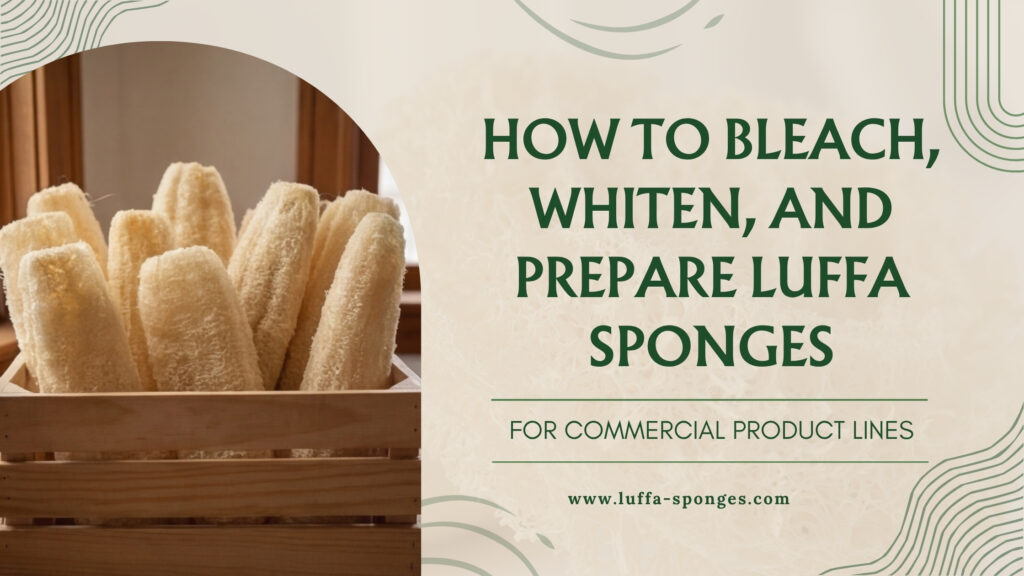
Walk into any premium spa retail display or natural wellness store and you will notice something immediately: the loofahs are bright, clean, and uniformly white. That appearance does not happen by accident. The process used to bleach, whiten, and prepare luffa sponges for commercial product lines is a precise, multi-step operation that directly determines whether a finished product reaches premium retail shelves or gets downgraded to commodity bulk categories. For wholesale buyers, understanding this process is the difference between sourcing a product your customers trust and sourcing one that generates returns and complaints. For individual consumers, it explains why two loofahs that look similar on the surface can perform so differently over time.
The global market for natural personal care products, including processed natural loofah, is projected to grow at 6 to 8 percent annually through 2030, and product presentation is one of the primary drivers of retail success in this category. Whitened and professionally prepared luffa sponges command significantly higher retail margins than their unprocessed natural counterparts, making commercial luffa whitening a topic that carries real financial implications for everyone in the supply chain.
This guide covers the full commercial whitening and preparation process from the moment a harvested luffa arrives at the processing facility to the point where it is packed and export-ready. Whether you are evaluating a supplier’s processing standards, building a private label luffa product line, or simply trying to understand what goes into the loofah you use every morning, this is the most detailed breakdown you will find anywhere.
Why Whitening Luffa Sponges Matters for Commercial Product Lines
The connection between luffa whitening and commercial success is more direct than most people realize. In retail environments, natural unbleached luffa typically presents in cream to light tan tones with occasional dark spots from the retting process. These products are perfectly functional, but they face a consistent disadvantage on retail shelves where consumer perception equates whiteness with cleanliness and premium quality.
A bright white luffa communicates hygiene, care, and premium manufacturing to the shopper who has never read a single word about how luffa is produced.
For B2B buyers supplying spa facilities, hotel amenity programs, or specialty wellness retailers, this perception gap translates directly into measurable revenue differences.
The Science Behind Luffa Discoloration
Freshly harvested luffa contains residual plant pigments, tannins, and trace organic compounds embedded in the fiber matrix during growth and retting. These compounds, particularly chlorogenic acid derivatives and various polyphenols common in cucurbit plant material, oxidize on exposure to air and moisture, producing the characteristic cream, tan, or brown tones of natural unprocessed luffa.
The retting process itself, during which harvested luffa is soaked to loosen and remove the outer skin, introduces additional discoloration risk. Bacteria active during retting produce metabolic byproducts that can stain fibers if water temperature, pH, or retting duration is not precisely controlled. This is one of the primary reasons that commercial whitening typically follows retting rather than attempting to prevent discoloration entirely, which is not practically achievable at scale.
Understanding this chemistry helps buyers evaluate supplier claims. A supplier who describes their luffa as naturally white without processing is either working with very specific varieties under very controlled conditions or is not being entirely accurate about their process.
The Commercial Luffa Whitening Process: Step by Step
The standard commercial process used to bleach, whiten, and prepare luffa sponges for product lines follows a consistent sequence across professional processing facilities. Variations exist in chemical concentrations, equipment types, and timing, but the fundamental stages are universal among quality-focused exporters.
| Stage | Process | Duration | Purpose |
|---|---|---|---|
| 1. Initial Rinse | Cold water flush | 10 to 15 minutes | Remove loose debris and surface dirt |
| 2. Retting | Warm water soak at 35 to 45 degrees Celsius | 12 to 48 hours | Loosen outer skin, begin pigment dilution |
| 3. Skin Removal | Manual or mechanical peeling | Variable | Expose fiber interior for processing |
| 4. Seed Removal | Shaking, washing, and inspection | 5 to 15 minutes | Remove seeds for cleaner final product |
| 5. Pre-bleach Wash | Mild detergent solution rinse | 15 to 20 minutes | Remove oils and soluble organic compounds |
| 6. Bleaching Bath | Hydrogen peroxide solution soak | 2 to 6 hours | Oxidize remaining pigments, achieve target whiteness |
| 7. Neutralization Rinse | Clean water flush with pH testing | 20 to 30 minutes | Remove bleaching agent residue |
| 8. Drying | Solar or mechanical drying | 24 to 72 hours | Reduce moisture below 12 percent |
| 9. Final Inspection | Visual grading and weight sorting | Variable | Quality control before packing |
| 10. Packing | Export-grade packaging per buyer spec | Variable | Protect finished product during transit |
Each stage in this sequence has failure points that affect the quality of the finished product. Buyers evaluating a supplier’s processing capabilities should ask specific questions about each stage, particularly retting control, bleaching agent type and concentration, and moisture content at packing.
Hydrogen Peroxide vs Sodium Hypochlorite: Choosing the Right Bleaching Agent
The two most common bleaching agents used in commercial luffa whitening are hydrogen peroxide and sodium hypochlorite, commonly known as bleach. Each has distinct advantages and limitations that affect product quality, safety, and marketability.
| Factor | Hydrogen Peroxide | Sodium Hypochlorite |
|---|---|---|
| Typical concentration used | 3 to 12 percent solution | 1 to 3 percent solution |
| Whitening effectiveness | Excellent, gradual | Strong, rapid |
| Fiber damage risk | Low at correct concentration | Moderate to high if overdone |
| Residue concern | Decomposes to water and oxygen | Chlorine residue possible |
| Processing time | 2 to 6 hours | 30 to 90 minutes |
| Odor in finished product | None | Chlorine smell possible |
| Preferred for premium retail | Yes | Not typically |
| Cost relative to output | Moderate | Lower |
For commercial product lines targeting premium spa, wellness, and natural retail channels, hydrogen peroxide is the professional standard. It achieves excellent whiteness without the chlorine residue concerns associated with sodium hypochlorite.
Sodium hypochlorite remains in use for industrial grade luffa applications and cost-sensitive commodity production where certification requirements are less stringent. Buyers building branded or private label product lines should specify hydrogen peroxide bleaching in their procurement requirements.
Standard EGEXO loofah is not bleached. Bleaching is available on request. See our products.
DIY Luffa Whitening for Consumers and Small Producers
Not every reader of this guide is sourcing container loads of commercially processed luffa. Home growers, small-scale producers, craft sellers, and eco-conscious consumers who want to process their own luffa benefit from understanding how the commercial process scales down for smaller applications.
What You Need for Home Luffa Whitening
The materials required for small-scale luffa whitening are accessible and inexpensive. Food-grade hydrogen peroxide at 3 to 6 percent concentration, available at pharmacies and online, is the recommended whitening agent for home use. Commercial-strength hydrogen peroxide above 12 percent requires careful handling and is not necessary for small batches.
You will also need a non-reactive container large enough to fully submerge the luffa, clean running water for rinsing, and a well-ventilated drying space with good airflow. Direct sunlight during the drying phase provides additional natural bleaching through UV exposure, which is a useful complement to hydrogen peroxide treatment for home processors.
Step-by-Step Home Whitening Process
- Harvest luffa at full maturity, indicated by a dry, papery outer skin and a rattling sound when shaken. Green, immature luffa will not whiten evenly and produces weaker fiber.
- Soak the unhusked luffa in warm water at approximately 40 degrees Celsius for 12 to 24 hours to loosen the outer skin. Change the water once during this period if the water becomes heavily discolored.
- Remove the outer skin by peeling with your hands under running water. The skin should come away relatively easily from mature luffa. Shake out seeds through the open ends.
- Rinse the peeled luffa thoroughly in clean cold water, squeezing gently several times to flush out any remaining retting water and loose debris.
- Prepare a soaking solution of food-grade 3 to 6 percent hydrogen peroxide, using enough to fully submerge your luffa pieces. Soak for 2 to 4 hours, turning occasionally to ensure even exposure.
- Rinse the whitened luffa thoroughly with clean water at least three times, squeezing between rinses to remove all bleaching solution residue.
- Dry in a well-ventilated location with direct sunlight if possible. Turn pieces every few hours to ensure even drying. Complete drying typically requires 24 to 48 hours depending on humidity.
- Test for complete drying by pressing firmly. No moisture should emerge and the luffa should feel light and crisp rather than slightly yielding or heavy.
This process consistently produces clean, bright luffa suitable for personal use, gift products, small craft batches, and evaluation samples. For consumers who prefer to purchase professionally processed product rather than DIY, exploring the bath and body loofah collection gives access to commercially whitened Egyptian luffa at individual purchase quantities.
Preparing Luffa for Specific Commercial Product Categories
Different commercial applications require specific preparation approaches beyond basic whitening. Understanding these category-specific requirements helps both buyers communicate specifications clearly and helps consumers understand why loofahs are formulated differently for different uses.
Bath and Body Products
Luffa prepared for bath and body retail requires the softest possible post-processing fiber texture. Over-bleaching or excessive mechanical processing hardens fibers and produces a product that feels harsh on skin, generating consumer complaints. Premium bath luffa is typically bleached to 85 to 95 percent whiteness on a standardized color scale, then lightly compressed and packaged to maintain a slightly yielding, skin-friendly feel.
Moisture content is particularly critical for bath luffa. Products packed above 14 percent moisture develop mold during transit and storage, which is a serious quality failure that can damage buyer-supplier relationships and trigger product recalls.
Kitchen and Household Scrubbers
Kitchen loofahs destined for dish scrubbing and surface cleaning applications benefit from a firmer fiber treatment. These products are often cut from harder sections of the luffa gourd and may receive less bleaching, retaining slightly more fiber stiffness that improves scrubbing performance on tough kitchen messes. Whitening for kitchen products prioritizes a clean appearance rather than the bright white demanded by cosmetic retail categories, allowing for slightly more variation in final color tone.
Spa and Hotel Amenity Lines
Spa and hotel amenity luffa represents the highest specification segment of the commercial market. These products require the most precise whitening, the most uniform sizing, and often custom cutting to fit proprietary packaging formats. Pet and spa grooming products fall into a related premium segment with their own specific softness and sizing requirements.
For buyers building spa or hotel amenity product lines, The private label loofah manufacturing service supports custom brand standards and packaging formats.
Supplier Evaluation: Assessing Commercial Luffa Processing Quality
Knowing how to evaluate a supplier’s whitening and preparation process is as important as understanding the process itself. The checklist below provides a structured framework for buyers assessing commercial luffa suppliers.
| Evaluation Point | What to Ask or Test | Acceptable Answer |
|---|---|---|
| Bleaching agent type | What chemical do you use for whitening? | Food-grade hydrogen peroxide for premium grade |
| Bleaching concentration | What is your standard solution concentration? | 3 to 12 percent hydrogen peroxide |
| Moisture content at packing | What is your moisture content specification? | Below 12 percent for export grade |
| Retting control | How do you control retting water temperature and duration? | Documented protocol with temperature monitoring |
| Fiber integrity testing | How do you assess fiber quality after bleaching? | Visual inspection plus compression testing |
| Color consistency | What color standard do you match against? | Reference color card or spectrophotometer reading |
| Sample availability | Can I receive pre-shipment samples? | Yes, without hesitation |
Suppliers who cannot answer these questions clearly either lack documentation of their processes or are not operating at a professional commercial level. See the EGEXO farm to export process.
To evaluate processing quality firsthand before placing a bulk order, use the sample request page. Samples are paid. The sample cost is credited to your first order of $1,000 or more, placed within 60 days.
Private Label Whitened Luffa: Building Your Own Product Line
For retailers and brand owners who want to sell whitened luffa under their own brand identity, private label production represents one of the most commercially attractive opportunities in the natural personal care category. The combination of strong consumer demand, high perceived value of premium white luffa, and the relative scarcity of branded natural loofah products creates genuine shelf space opportunity.
A successful private label whitened luffa program requires three aligned elements: a supplier with precise whitening capabilities who can deliver consistent color batch to batch, a packaging specification that protects the product’s bright appearance during retail display, and a quality standard that is documented and enforceable across repeat orders.
The custom loofah product design service supports buyers who want their own specifications.
For buyers ready to explore private label possibilities, downloading the complete EGEXO product catalog provides a starting point for understanding the full range of whitened and processed luffa options available for custom branding.
Pros and Cons: Bleached vs Natural Unbleached Luffa for Commercial Use
| Factor | Bleached Whitened Luffa | Natural Unbleached Luffa |
|---|---|---|
| Visual appeal for retail | High, commands premium shelf position | Moderate, appeals to raw natural segment |
| Consumer perception | Clean, hygienic, premium | Earthy, minimally processed, authentic |
| Processing cost | Higher due to bleaching stage | Lower, fewer processing steps |
| Shelf life | 18 to 24 months properly stored | 12 to 18 months with good moisture control |
| Fiber integrity | Equal if bleaching is correctly controlled | Equal, no chemical exposure |
| Target market fit | Spa, cosmetic retail, hotel amenities | Eco-raw segment, DIY, craft, specialty |
This comparison shows that neither option is universally superior. The right choice depends entirely on your target market and retail channel. Buyers serving premium spa and wellness retail should default to whitened product. Buyers targeting raw natural product consumers or eco-certification-focused retailers may find unbleached luffa better aligned with their brand positioning.
Expert Insight from EGEXO
Since 2015 we have exported Egyptian luffa, and it has taught us one consistent lesson: the quality of a whitened luffa product is determined more by what happens before the bleaching bath than during it.
Farms that harvest at precise maturity, control retting temperature within a two-degree window, and complete skin removal cleanly before the bleaching stage produce sponges that whiten evenly and completely in a single treatment cycle. Farms that rush any of these pre-bleach steps end up with uneven color, weak spots in the fiber, or residual organic material that resists whitening and requires either repeat treatment or downgrading.
For buyers, this means that a supplier’s farm and retting practices are as important to evaluate as their bleaching process itself. Ask your supplier where quality control begins. If the answer starts at the bleaching tank rather than the field, that is worth noting.
Request a bulk quote to discuss your specific whitening and preparation requirements with the EGEXO export team.
FAQ Section
Q1: Is bleached luffa safe to use on skin?
A: Bleached luffa should be rinsed thoroughly before use. Standard EGEXO loofah is not bleached. Bleaching is available on request.
Q2: What concentration of hydrogen peroxide is used to whiten luffa commercially?
A: Commercial luffa whitening typically uses food-grade hydrogen peroxide at concentrations between 3 and 12 percent depending on the target whiteness level and fiber sensitivity of the specific luffa variety. Concentrations above 12 percent can damage fiber integrity and reduce the usable lifespan of the finished sponge. For home whitening, 3 to 6 percent food-grade hydrogen peroxide available at pharmacies is sufficient and safe for small batches, producing results comparable to light commercial processing in 2 to 4 hours of soaking time.
Q3: How do I whiten luffa at home without damaging the fibers?
A: Whitening luffa at home without fiber damage requires using food-grade hydrogen peroxide at 3 to 6 percent concentration, avoiding soaking times longer than 4 hours, and rinsing thoroughly with clean water at least three times after treatment. Over-soaking or using higher concentrations than necessary weakens the fiber matrix, producing a sponge that shreds during use. Sun-drying after treatment provides additional gentle whitening through UV exposure without any chemical risk. The complete step-by-step home whitening process is detailed earlier in this guide.
Q4: What is the difference between bleached and natural luffa for commercial buyers?
A: For commercial buyers, the primary differences between bleached and natural luffa lie in retail price positioning, target market fit, and processing cost. Natural unbleached luffa serves the eco-raw segment better and carries lower processing costs. Fiber quality is equal between both when bleaching is correctly controlled. The right choice depends on your retail channel and brand positioning rather than any inherent quality difference between the two product types.
Q5: How can wholesale buyers verify that a supplier’s whitening process is safe and effective?
A: Wholesale buyers can verify supplier whitening process quality through four key steps. First, request documentation of the bleaching agent type and concentration used. Second, ask for residual bleach testing results from recent production batches. Third, order pre-shipment samples and evaluate color consistency, odor neutrality, and fiber integrity before approving bulk production. Fourth, review the supplier’s quality standards documentation. Read the EGEXO quality standards and why choose EGEXO pages.
Q6: Does bleaching reduce the durability or lifespan of luffa sponges?
A: Correctly executed commercial bleaching using food-grade hydrogen peroxide at appropriate concentrations does not reduce luffa durability or lifespan. Whitened luffa has the same usable life as unbleached luffa of the same fiber quality. Over-bleaching with excessive concentrations or extended soaking times does damage fiber, which is one of the key reasons why professional processing protocols with strict concentration and timing controls are essential for maintaining product quality.
Q7: What MOQ applies to orders of commercially whitened luffa?
A: At EGEXO: No minimum order on standard products. Private label from 1,000 units. Requesting a quotation is the most direct path to getting accurate MOQ information for your specific product needs.
Q8: Can I order custom whiteness levels for my private label luffa line?
A: Yes. Professional commercial luffa processors can calibrate whitening to target specific color levels, from light cream through bright white, to match your brand aesthetic or product line specifications. Custom whiteness levels require clear specification of the target color standard, which experienced suppliers manage using reference color cards or spectrophotometer readings to ensure batch-to-batch consistency across repeat orders. EGEXO’s custom loofah product design service accommodates custom whiteness specifications as part of a broader private label development process.
Conclusion
The process used to bleach, whiten, and prepare luffa sponges for commercial product lines is one of the most consequential quality determinants in the entire luffa supply chain. It affects retail price positioning, consumer perception, safety, shelf life, and the success of private label programs. Understanding this process gives both wholesale buyers and individual consumers the knowledge to evaluate products with real confidence rather than relying on surface appearances.
Key Takeaways:
- Pre-bleach stages including retting control, skin removal, and pre-wash are as important to final whiteness quality as the bleaching bath itself.
- Home whitening with 3 to 6 percent food-grade hydrogen peroxide is safe and effective for small batches following the correct step-by-step process.
- Supplier verification through documentation requests, residue testing data, and pre-shipment samples is essential before committing to commercial whitened luffa orders.
Ready to source commercially whitened Egyptian luffa that meets premium retail standards?
For Wholesale Buyers: Request a quote or download our complete product catalog to explore whitened luffa sizes and private label options.
Products: see our products or request samples to evaluate whitening quality before committing to a larger purchase.