
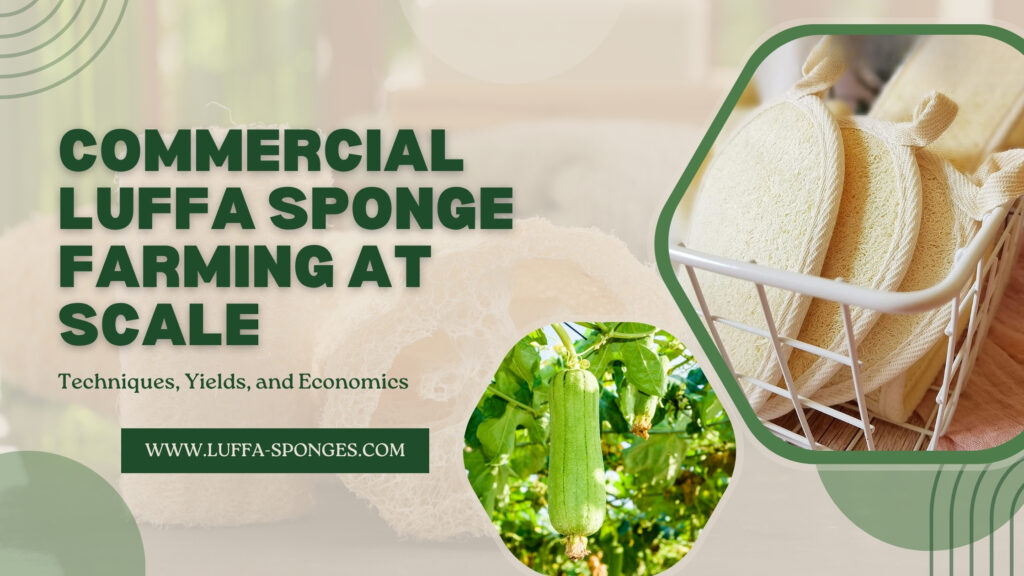
Few agricultural products bridge the gap between ancient farming tradition and modern industrial demand quite like the luffa. Known botanically as Luffa aegyptiaca or Luffa acutangula, this cucurbit vine produces a fibrous skeletal structure that has found its way into bathroom routines, surgical applications, industrial filtration, and premium spa product lines worldwide. Commercial luffa sponge farming at scale is no longer a niche pursuit. It is a growing sector attracting serious agricultural investment, B2B supply chain interest, and consumer demand driven by the global shift toward natural, biodegradable alternatives to synthetic sponges.
For wholesale buyers sourcing in bulk, understanding how luffa is grown, processed, and graded at scale gives you the information you need to evaluate suppliers with confidence. For individual consumers and eco-conscious shoppers, knowing what goes into producing a high-quality loofah sponge helps you make smarter purchasing decisions. This guide covers both worlds with equal depth, walking through farming techniques, yield benchmarks, quality economics, and what separates a premium luffa from a commodity product.
Whether you are a distributor evaluating minimum order quantities, a retailer building a sustainable product line, or simply someone curious about what is behind the loofah hanging in your shower, this is the most comprehensive look at commercial luffa farming you will find anywhere online.
What Makes Luffa Farming Commercially Viable at Scale
Luffa is a warm-season crop that thrives in tropical and subtropical climates. Commercial luffa sponge farming at scale requires consistent temperatures between 25 and 35 degrees Celsius, a growing season of 150 to 200 days, well-drained sandy loam soil, and reliable irrigation access. These conditions are not universally available, which is why Egypt has emerged as one of the world’s leading producers and exporters of high-quality luffa.
The Nile Delta region, in particular, offers an ideal agricultural combination of fertile soil, extended warm seasons, and established farming infrastructure. Egyptian loofah is softer, with a looser fibre weave than Asian loofah. EGEXO has been exporting Egyptian loofah since 2015.
Why Egypt Leads Global Luffa Production
Egyptian loofah benefits from a combination of geographic, climatic, and agricultural factors that are difficult to replicate elsewhere. The Nile Delta provides natural mineral-rich irrigation water that promotes dense fiber development. Extended growing seasons allow fruits to reach full maturity before harvest, which directly affects fiber strength and sponge longevity. Egyptian farmers have also developed multi-generational knowledge of variety selection, trellising methods, and post-harvest processing that keeps quality consistently high at scale.
For buyers evaluating sourcing options, Egyptian luffa commands respect across international quality standards. For consumers, it means the product you purchase from a reputable Egyptian supplier is likely to outlast and outperform cheaper alternatives in both scrubbing effectiveness and durability.
Farming Techniques Used in Large-Scale Luffa Production
Land Preparation and Seed Selection
Large-scale luffa farming begins with thorough land preparation. Fields are typically deep-plowed to 30 to 40 centimeters to break compacted subsoil layers. Organic matter, often well-composted manure, is incorporated at rates of 20 to 30 tons per hectare before planting. Soil pH is adjusted to a target range of 6.0 to 6.8, which optimizes nutrient uptake throughout the growing cycle.
Seed selection at commercial scale involves careful variety testing. Luffa aegyptiaca is favored for its larger cylindrical sponges, which suit both body and kitchen applications. Seeds are typically germinated in controlled nursery conditions for 10 to 14 days before transplanting to the field, which improves establishment rates and reduces crop failure risk.
Trellising Systems for Volume Production
One of the most critical decisions in commercial luffa sponge farming at scale is the trellising system. Luffa vines can reach 3 to 5 meters in length and require vertical support to produce straight, well-formed fruits. Horizontal overhead trellis systems at heights of 2.0 to 2.5 meters are the standard choice for large operations because they allow fruits to hang freely, reducing deformation and making harvest significantly easier for field workers.
Wire and post trellis systems spaced at 1.5 to 2.0 meters between rows allow adequate airflow, which is critical for disease control. High-density planting without proper trellising leads to irregular fruit shapes, which reduces the percentage of sponges that meet export quality grades.
Irrigation and Fertilization Practices
Commercial luffa requires consistent moisture, particularly during flowering and fruit development stages. Drip irrigation is the preferred method at scale because it delivers water directly to the root zone, reduces foliar disease pressure, and improves water use efficiency by 30 to 40 percent compared to flood irrigation.
Fertilization programs at commercial scale typically follow a staged approach. Nitrogen-heavy formulations support vegetative growth in early stages, while potassium and phosphorus inputs are increased during flowering to support fruit set and fiber development. Micronutrient supplementation, particularly zinc and boron, has been shown to improve fiber quality in research trials conducted across Egyptian growing regions.
Post-Harvest Processing: From Vine to Export-Ready Sponge
Retting and Fiber Extraction
Once luffa fruits reach full maturity, indicated by a dry, papery outer skin and a hollow, fibrous interior that rattles when shaken, the post-harvest process begins. Retting, the process of soaking harvested fruits in water to loosen the outer skin, is a critical step that affects both the cleanliness and color of the finished sponge.
Water temperature and retting duration both affect quality. Over-retting produces dark, discolored sponges that do not meet export grade standards. Under-retting leaves skin residue embedded in the fibers, which affects texture and hygiene. Commercial operations that have refined this process over decades achieve consistent cream to light tan coloration. See the EGEXO farm to export process.
Drying, Bleaching, and Sorting
After retting and skin removal, sponges are dried in open-air solar drying facilities or mechanical dryers. Target moisture content for export-grade sponges is below 12 percent. Higher moisture content creates conditions for mold development during shipping, which is a common quality failure point for suppliers who rush post-harvest processing.
Standard EGEXO loofah is not bleached. Bleaching is done only on request. Natural, unbleached sponges are increasingly preferred by eco-conscious consumers and retailers focused on minimal processing. Both grades are commercially viable, serving different market segments at different price points.
Sorting and grading is the final step before packing. Sponges are separated by length, diameter, firmness, and visual appearance. Buyers can read the EGEXO quality standards.
For consumers, this grading reality means that premium retail loofahs genuinely differ from budget options. The price difference reflects real differences in fiber density, harvest timing, processing quality, and consistency of performance.
Economic Analysis: Costs, Margins, and Market Opportunity
Production Cost Structure
Commercial luffa production involves several cost categories that affect the final export price and, ultimately, the retail margin available to buyers and retailers.
| Cost Category | Approximate Share of Total Cost |
|---|---|
| Land preparation and inputs | 25 to 30 percent |
| Irrigation and water management | 15 to 20 percent |
| Labor (planting, trellising, harvest) | 30 to 35 percent |
| Post-harvest processing | 10 to 15 percent |
| Packing and export logistics | 10 to 15 percent |
Labor is consistently the largest cost variable, which is why regions with skilled, lower-cost agricultural labor maintain a competitive advantage in global luffa supply. Egypt’s combination of agricultural expertise and favorable labor economics underpins its position as a dominant luffa exporter.
Market Growth and Demand Drivers
The global natural sponge and loofah market has experienced consistent growth driven by several converging trends. The plastic-free movement has positioned natural luffa as a direct replacement for synthetic bath sponges, opening retail channels that were previously dominated by petroleum-based products.
For wholesale buyers evaluating the commercial opportunity, this demand trajectory means that building loofah supply relationships now positions businesses ahead of competition in a growing category.
For individual consumers, growing market demand has fortunately also increased product availability and driven quality improvements across commercial luffa offerings, making premium Egyptian luffa more accessible than it was a decade ago.
Supplier Evaluation: What Separates a Premium Luffa Supplier from a Commodity Vendor
The Checklist Every Buyer Should Use
Evaluating a commercial luffa supplier requires looking beyond price per unit. The table below outlines the criteria that distinguish a serious long-term supplier from a commodity broker with limited quality control.
| Evaluation Criteria | What to Look For | Red Flags |
|---|---|---|
| Farm ownership or direct farm access | Supplier controls or has direct relationships with growing operations | Pure trading company with no farm knowledge |
| Quality documentation | Written grading standards, inspection reports | Vague quality claims with no supporting documentation |
| Sample availability | Provides samples before bulk order commitment | Reluctance to send samples or samples that differ from bulk delivery |
| Export experience | Established track record with international shipping | Limited export history or no references |
| Production capacity | Can demonstrate scale to meet your MOQ consistently | Inflated capacity claims without evidence |
| Processing transparency | Explains retting, drying, and sorting methods | No information on post-harvest handling |
| Certifications | ISO or other relevant certifications | No certifications for premium market positioning |
Buyers can review why choose EGEXO and access a detailed product catalog to evaluate the full range of offerings before making sourcing commitments.
Private Label and Custom Product Opportunities
One of the most significant commercial opportunities in the luffa category is private label production. Spa brands, wellness retailers, and eco-product companies increasingly want branded loofah products that carry their identity, not a supplier’s. EGEXO’s private label loofah manufacturing and custom loofah product design services allow buyers to build exclusive product lines backed by Egyptian agricultural quality.
Applications Across Consumer and Industrial Markets
Personal Care and Spa Use
The largest consumer market for commercially farmed luffa remains personal care. Bath and body loofahs are used by millions of consumers daily for exfoliation, circulation stimulation, and skin cleansing. The natural fiber structure of luffa provides mechanical exfoliation that removes dead skin cells without the microplastic pollution associated with synthetic alternatives. For consumers, this makes luffa one of the few personal care tools that genuinely improves with age, softening slightly after repeated use while maintaining scrubbing effectiveness.
Spa and wellness facilities sourcing in bulk benefit from consistent quality across large orders, which is precisely where Egyptian commercial farming at scale delivers the most value. See our products for bath and body options suitable for spa procurement.
Kitchen and Household Applications
Kitchen loofahs represent a fast-growing consumer segment as households replace synthetic dish scrubbers with natural alternatives. Commercial farming produces specific cuts and preparations optimized for kitchen use, including harder, less-processed fiber sections that withstand grease and heat better than softer bath grades.
For distributors serving housewares retailers, kitchen luffa products offer strong repeat purchase potential because consumers replace them regularly, typically every 4 to 6 weeks with proper care.
Pet Grooming and Specialty Markets
An emerging commercial application for farmed luffa is the pet and spa grooming segment. Specially selected and processed luffa cuts are used in pet bathing tools, offering a gentle yet effective scrubbing surface that is completely natural and biodegradable. For pet product retailers and groomers, this represents a differentiated product opportunity in a market that is rapidly shifting toward natural ingredient formulations.
Pros and Cons: Natural Luffa vs Synthetic Sponge at Commercial Scale
| Factor | Natural Luffa (Egyptian) | Synthetic Sponge |
|---|---|---|
| Environmental impact | Fully biodegradable, compostable | Petroleum-based, landfill waste |
| Exfoliation quality | Natural mechanical texture, improves skin circulation | Smooth, limited exfoliation benefit |
| Bacterial retention | Lower with proper drying and care | Higher due to dense closed-cell structure |
| Production scalability | Climate-dependent, requires skilled farming | Fully industrial, climate-independent |
| Consumer perception | Premium, natural, sustainable | Commodity, declining brand appeal |
| Retail margin potential | Higher, especially premium and private label | Compressed due to commodity pricing |
| Wholesale MOQ flexibility | Variable, depends on supplier scale | High, factory production focused |
This comparison makes clear why natural luffa is gaining commercial ground. For wholesale buyers, the margin and positioning advantages of natural luffa in an era of sustainability-focused retail are compelling. For consumers, the durability and exfoliation data support choosing natural luffa over cheaper synthetic alternatives.
Expert Insight from EGEXO
Since 2015 EGEXO has exported Egyptian luffa, and we have observed one consistent pattern among the most successful commercial farming operations: quality is determined at the field level, not in the packing room.
Farms that achieve consistently premium export grades invest disproportionately in three areas: trellising infrastructure that produces straight, marketable fruits, precise irrigation timing that avoids water stress during critical fiber development windows, and retting protocols that are strictly time and temperature controlled. No amount of post-harvest sorting can rescue a sponge that was grown under suboptimal conditions. Our loofah comes from our own farms and partner farms.
Request a quote or order samples to evaluate our quality firsthand.
FAQ Section
Q1: What is commercial luffa sponge farming at scale, and how is it different from small-scale growing?
Commercial luffa sponge farming at scale refers to organized agricultural operations cultivating luffa across multiple hectares using professional trellis systems, managed irrigation, and systematic post-harvest processing designed to meet export quality standards. Unlike backyard or hobby growing, commercial operations maintain consistent grading, documented quality standards, and production volumes sufficient to supply wholesale buyers with reliable quantities across multiple growing seasons. Egypt is the global leader in this type of organized, export-focused luffa cultivation.
Q4: What is the minimum order quantity for wholesale luffa purchases from Egyptian suppliers?
At EGEXO: No minimum order on standard products. Private label from 1,000 units. Request a quotation for specific MOQ details.
Q5: Is Egyptian luffa better than luffa grown in other countries?
Egyptian loofah is softer, with a looser fibre weave than Asian loofah.
Q6: How long does a commercial-grade luffa sponge last with proper care?
A luffa sponge lasts longer with proper maintenance. Proper care includes rinsing thoroughly after each use, wringing out excess water, hanging to dry in a well-ventilated area between uses, and replacing at the first signs of persistent odor or fiber breakdown. Consumers who store their loofah compressed or wet will see significantly shorter lifespans.
Q7: Can I order custom or private label luffa products through a commercial supplier?
Yes. Commercial luffa suppliers with direct farm access and processing facilities can accommodate custom sizing, bleaching specifications, branding, and packaging requirements for private label programs. EGEXO offers private label loofah manufacturing and custom loofah product design services that allow spa brands, wellness retailers, and eco-product companies to build exclusive product lines backed by Egyptian agricultural quality. Custom programs typically require discussion of minimum volume commitments and lead times to coordinate production planning.
Q8: What certifications should I look for when sourcing commercial luffa from an overseas supplier?
When sourcing commercial luffa internationally, buyers should look for suppliers who can provide documentation supporting their quality claims. Relevant certifications depending on your market and application may include ISO quality management certifications indicating systematic quality control processes, and export health documentation from the country of origin. Our company management system is certified (ISO 9001, 14001, 45001). Documents we hold: ISO certificates, Certificate of Origin or EUR.1, Phytosanitary Certificate and Export License.
Conclusion
Commercial luffa sponge farming at scale is a technically demanding, economically rewarding agricultural enterprise that produces one of the world’s most versatile natural fiber products. The best results, both in the field and in the supply chain, come from operations that combine deep agricultural knowledge with disciplined post-harvest processing and transparent quality standards. Egyptian luffa is available from EGEXO.
Key Takeaways:
- Commercial luffa farming at scale requires specific climate conditions, professional trellising, precision irrigation, and controlled post-harvest processing to produce export-grade quality consistently.
- Egyptian loofah is softer, with a looser fibre weave than Asian loofah
- Quality grading into premium, standard, and industrial categories allows buyers to match product specification precisely to their market needs and price point.
- The global demand for natural, biodegradable personal care products is growing at 5 to 8 percent annually, making commercial luffa supply chain relationships increasingly strategic for retailers and distributors.
Ready to experience Egyptian loofah quality at the level your business or lifestyle deserves?
For Wholesale Buyers: Request a quote or download our complete product catalog to explore the full range of sizes and private label options.
Products: see our products or request samples to evaluate quality before committing to a larger purchase.