
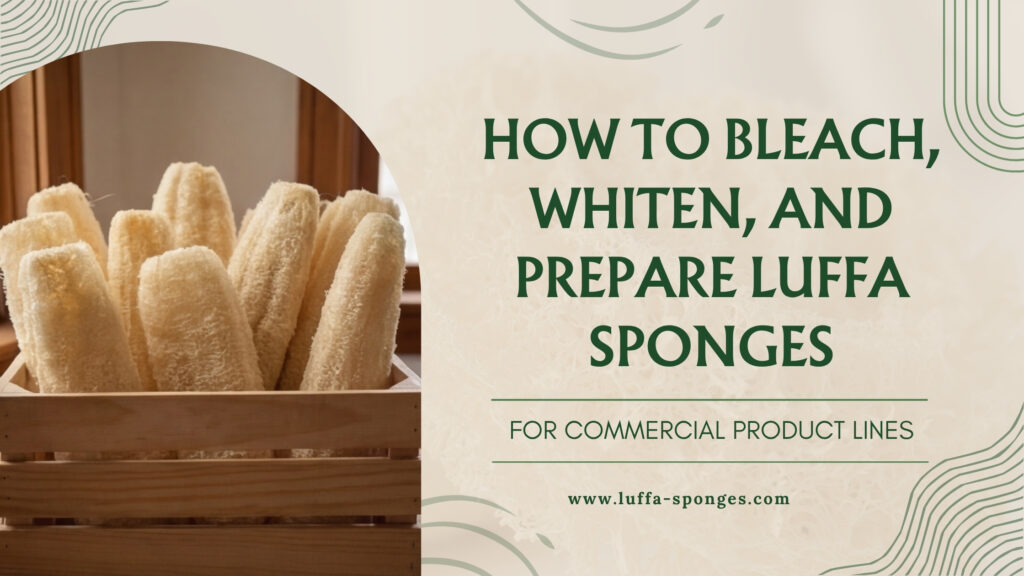
Walk into any premium spa retail display or natural wellness store and you will notice something immediately: the loofahs are bright, clean, and uniformly white. That appearance does not happen by accident. The process used to bleach, whiten, and prepare luffa sponges for commercial product lines is a precise, multi-step operation that directly determines whether a finished product reaches premium retail shelves or gets downgraded to commodity bulk categories. For wholesale buyers, understanding this process is the difference between sourcing a product your customers trust and sourcing one that generates returns and complaints. For individual consumers, it explains why two loofahs that look similar on the surface can perform so differently over time.
This guide covers the full commercial whitening and preparation process from the moment a harvested luffa arrives at the processing facility to the point where it is packed and export-ready. Whether you are evaluating a supplier’s processing standards, building a private label luffa product line, or simply trying to understand what goes into the loofah you use every morning, this guide walks through it step by step.
Why Whitening Luffa Sponges Matters for Commercial Product Lines
The connection between luffa whitening and commercial success is more direct than most people realize. In retail environments, natural unbleached luffa typically presents in cream to light tan tones with occasional dark spots from the retting process. These products are perfectly functional, but they face a consistent disadvantage on retail shelves where consumer perception equates whiteness with cleanliness and premium quality.
A bright white luffa communicates hygiene, care, and premium manufacturing to the shopper who has never read a single word about how luffa is produced.
For B2B buyers supplying spa facilities, hotel amenity programs, or specialty wellness retailers, this perception gap matters commercially.
The Science Behind Luffa Discoloration
Freshly harvested luffa contains residual plant pigments, tannins, and trace plant compounds embedded in the fiber matrix during growth and retting. These compounds, particularly chlorogenic acid derivatives and various polyphenols common in cucurbit plant material, oxidize on exposure to air and moisture, producing the characteristic cream, tan, or brown tones of natural unprocessed luffa.
The retting process itself, during which harvested luffa is soaked to loosen and remove the outer skin, introduces additional discoloration risk. Bacteria active during retting produce metabolic byproducts that can stain fibers if water temperature, pH, or retting duration is not precisely controlled. This is one of the primary reasons that commercial whitening typically follows retting rather than attempting to prevent discoloration entirely, which is not practically achievable at scale.
Understanding this chemistry helps buyers evaluate supplier claims. A supplier who describes their luffa as naturally white without processing is either working with very specific varieties under very controlled conditions or is not being entirely accurate about their process.
Planning your own brand? Ask EGEXO about private label luffa from 1,000 units, with bleaching or colours on request.
The Commercial Luffa Whitening Process: Step by Step
The standard commercial process used to bleach, whiten, and prepare luffa sponges for product lines follows a consistent sequence across professional processing facilities. Variations exist in chemical concentrations, equipment types, and timing, but the fundamental stages are universal among quality-focused exporters.
Each stage in this sequence has failure points that affect the quality of the finished product.
Hydrogen Peroxide vs Sodium Hypochlorite: Choosing the Right Bleaching Agent
The two most common bleaching agents used in commercial luffa whitening are hydrogen peroxide and sodium hypochlorite, commonly known as bleach. Each has distinct advantages and limitations that affect product quality, safety, and marketability.
| Factor | Hydrogen Peroxide | Sodium Hypochlorite |
|---|---|---|
| Whitening effectiveness | Excellent, gradual | Strong, rapid |
| Fiber damage risk | Low at correct concentration | Moderate to high if overdone |
| Residue concern | Decomposes to water and oxygen | Chlorine residue possible |
| Processing time | 2 to 6 hours | 30 to 90 minutes |
| Odor in finished product | None | Chlorine smell possible |
| Preferred for premium retail | Yes | Not typically |
| Cost relative to output | Moderate | Lower |
For commercial product lines targeting premium spa, wellness, and natural retail channels, hydrogen peroxide is the professional standard. It achieves excellent whiteness without the chlorine residue concerns associated with sodium hypochlorite.
Sodium hypochlorite remains in use for industrial luffa applications and cost-sensitive commodity production where certification requirements are less stringent. Buyers building branded or private label product lines should specify hydrogen peroxide bleaching in their procurement requirements.
Standard EGEXO loofah is not bleached. Bleaching is available on request. See our products.
DIY Luffa Whitening for Consumers and Small Producers
Not every reader of this guide is sourcing container loads of commercially processed luffa. Home growers, small-scale producers, craft sellers, and eco-conscious consumers who want to process their own luffa benefit from understanding how the commercial process scales down for smaller applications.
What You Need for Home Luffa Whitening
The materials required for small-scale luffa whitening are accessible and inexpensive. Mild hydrogen peroxide solution, available at pharmacies and online, is the usual whitening agent for home use. Stronger commercial solutions require careful handling and are not necessary for small batches.
You will also need a non-reactive container large enough to fully submerge the luffa, clean running water for rinsing, and a well-ventilated drying space with good airflow. Direct sunlight during the drying phase provides additional natural bleaching through UV exposure, which is a useful complement to hydrogen peroxide treatment for home processors.
Step-by-Step Home Whitening Process
- Harvest luffa at full maturity, indicated by a dry, papery outer skin and a rattling sound when shaken. Green, immature luffa will not whiten evenly and produces weaker fiber.
- Change the water once during this period if the water becomes heavily discolored.
- Remove the outer skin by peeling with your hands under running water. The skin should come away relatively easily from mature luffa. Shake out seeds through the open ends.
- Rinse the peeled luffa thoroughly in clean cold water, squeezing gently several times to flush out any remaining retting water and loose debris.
- Prepare a soaking solution of mild hydrogen peroxide, using enough to fully submerge your luffa pieces. Soak for 2 to 4 hours, turning occasionally to ensure even exposure.
- Rinse the whitened luffa thoroughly with clean water at least three times, squeezing between rinses to remove all bleaching solution residue.
- Dry in a well-ventilated location with direct sunlight if possible. Turn pieces every few hours to ensure even drying. Complete drying typically requires 24 to 48 hours depending on humidity.
- Test for complete drying by pressing firmly. No moisture should emerge and the luffa should feel light and crisp rather than slightly yielding or heavy.
This process consistently produces clean, bright luffa suitable for personal use, gift products, small craft batches, and evaluation samples. For consumers who prefer to purchase professionally processed product rather than DIY, exploring the bath and body loofah collection gives access to commercially whitened Egyptian luffa at individual purchase quantities.
Preparing Luffa for Specific Commercial Product Categories
Different commercial applications require specific preparation approaches beyond basic whitening. Understanding these category-specific requirements helps both buyers communicate specifications clearly and helps consumers understand why loofahs are formulated differently for different uses.
Bath and Body Products
Luffa prepared for bath and body retail requires the softest possible post-processing fiber texture. Over-bleaching or excessive mechanical processing hardens fibers and produces a product that feels harsh on skin, generating consumer complaints. Bath luffa is typically bleached only as far as needed, then lightly compressed and packaged to maintain a slightly yielding, skin-friendly feel.
Products packed while still damp develop mold during transit and storage, which is a serious quality failure that can damage buyer-supplier relationships and trigger product recalls.
Kitchen and Household Scrubbers
These products are often cut from harder sections of the luffa gourd and may receive less bleaching, retaining slightly more fiber stiffness that improves scrubbing performance on tough kitchen messes. Whitening for kitchen products prioritizes a clean appearance rather than the bright white demanded by cosmetic retail categories, allowing for slightly more variation in final color tone.
Spa and Hotel Amenity Lines
Spa and hotel amenity luffa represents the highest specification segment of the commercial market. These products require the most precise whitening, the most uniform sizing, and often custom cutting to fit proprietary packaging formats. Pet and spa grooming products fall into a related premium segment with their own specific softness and sizing requirements.
For buyers building spa or hotel amenity product lines, The private label loofah manufacturing service supports custom brand standards and packaging formats.
Supplier Evaluation: Assessing Commercial Luffa Processing Quality
Knowing how to evaluate a supplier’s whitening and preparation process is as important as understanding the process itself. The checklist below provides a structured framework for buyers assessing commercial luffa suppliers.
Suppliers who cannot answer these questions clearly either lack documentation of their processes or are not operating at a professional commercial level. See the EGEXO farm to export process.
To evaluate processing quality firsthand before placing a bulk order, use the sample request page. Samples are paid. The sample cost is credited to your first order of $1,000 or more, placed within 60 days.
Private Label Whitened Luffa: Building Your Own Product Line
For retailers and brand owners who want to sell whitened luffa under their own brand identity, private label production represents one of the most commercially attractive opportunities in the natural personal care category. The combination of strong consumer demand, high perceived value of premium white luffa, and the relative scarcity of branded natural loofah products creates genuine shelf space opportunity.
A successful private label whitened luffa program requires three aligned elements: a supplier with precise whitening capabilities who can deliver consistent color batch to batch, a packaging specification that protects the product’s bright appearance during retail display, and a quality standard that is documented and enforceable across repeat orders.
The custom loofah product design service supports buyers who want their own specifications.
For buyers ready to explore private label possibilities, downloading the complete EGEXO product catalog provides a starting point for understanding the full range of whitened and processed luffa options available for custom branding.
Pros and Cons: Bleached vs Natural Unbleached Luffa for Commercial Use
| Factor | Bleached Whitened Luffa | Natural Unbleached Luffa |
|---|---|---|
| Visual appeal for retail | High, commands premium shelf position | Moderate, appeals to raw natural segment |
| Consumer perception | Clean, hygienic, premium | Earthy, minimally processed, authentic |
| Processing cost | Higher due to bleaching stage | Lower, fewer processing steps |
| Fiber integrity | Equal if bleaching is correctly controlled | Equal, no chemical exposure |
| Target market fit | Spa, cosmetic retail, hotel amenities | Eco-raw segment, DIY, craft, specialty |
This comparison shows that neither option is universally superior. The right choice depends entirely on your target market and retail channel. Buyers serving premium spa and wellness retail should default to whitened product. Buyers targeting raw natural product consumers or eco-certification-focused retailers may find unbleached luffa better aligned with their brand positioning.
What EGEXO Has Learned
Since 2015 we have exported Egyptian luffa, and it has taught us one consistent lesson: the quality of a whitened luffa product is determined more by what happens before the bleaching bath than during it.
Farms that harvest at precise maturity, control retting temperature within a two-degree window, and complete skin removal cleanly before the bleaching stage produce sponges that whiten evenly and completely in a single treatment cycle. Farms that rush any of these pre-bleach steps end up with uneven color, weak spots in the fiber, or residual plant material that resists whitening and requires either repeat treatment or downgrading.
For buyers, this means that a supplier’s farm and retting practices are as important to evaluate as their bleaching process itself. Ask your supplier where quality control begins. If the answer starts at the bleaching tank rather than the field, that is worth noting.
Request a bulk quote to discuss your specific whitening and preparation requirements with the EGEXO export team.
FAQ Section
Q1: Is bleached luffa safe to use on skin?
A: Bleached luffa should be rinsed thoroughly before use. Standard EGEXO loofah is not bleached. Bleaching is available on request.
Q2: What is used to whiten luffa commercially?
A: Commercial luffa whitening typically uses hydrogen peroxide solution, with the concentration chosen for the target whiteness and the fiber sensitivity of the luffa. Overly strong solutions can damage fiber integrity and reduce the usable lifespan of the finished sponge. For home whitening, a mild pharmacy-type hydrogen peroxide solution is enough for small batches, soaked for a few hours.
Q3: How do I whiten luffa at home without damaging the fibers?
A: Whitening luffa at home without fiber damage requires using mild hydrogen peroxide, avoiding soaking times longer than 4 hours, and rinsing thoroughly with clean water at least three times after treatment. Over-soaking or using higher concentrations than necessary weakens the fiber matrix, producing a sponge that shreds during use. Sun-drying after treatment provides additional gentle whitening through UV exposure without any chemical risk. The complete step-by-step home whitening process is detailed earlier in this guide.
Q4: What is the difference between bleached and natural luffa for commercial buyers?
A: For commercial buyers, the primary differences between bleached and natural luffa lie in retail price positioning, target market fit, and processing cost. Natural unbleached luffa serves the eco-raw segment better and carries lower processing costs. Fiber quality is equal between both when bleaching is correctly controlled. The right choice depends on your retail channel and brand positioning rather than any inherent quality difference between the two product types.
Q5: How can wholesale buyers verify that a supplier’s whitening process is safe and effective?
A: Wholesale buyers can verify supplier whitening process quality through four key steps. First, request documentation of the bleaching agent type and concentration used. Second, ask for residual bleach testing results from recent production batches. Third, order pre-shipment samples and evaluate color consistency, odor neutrality, and fiber integrity before approving bulk production. Fourth, review the supplier’s quality standards documentation. Read the EGEXO quality standards and why choose EGEXO pages.
Q6: Does bleaching reduce the durability or lifespan of luffa sponges?
A: Correctly executed commercial bleaching using hydrogen peroxide at appropriate concentrations does not reduce luffa durability or lifespan. Whitened luffa has the same usable life as unbleached luffa of the same fiber quality. Over-bleaching with excessive concentrations or extended soaking times does damage fiber, which is one of the key reasons why professional processing protocols with strict concentration and timing controls are essential for maintaining product quality.
Q7: What MOQ applies to orders of commercially whitened luffa?
A: At EGEXO: No minimum order on standard products. Private label from 1,000 units. Requesting a quotation is the most direct path to getting accurate MOQ information for your specific product needs.
Q8: Can I order custom whiteness levels for my private label luffa line?
A: Yes. Professional commercial luffa processors can calibrate whitening to target specific color levels, from light cream through bright white, to match your brand aesthetic or product line specifications. Custom whiteness levels require clear specification of the target color standard, which experienced suppliers manage using reference color cards or spectrophotometer readings to ensure batch-to-batch consistency across repeat orders. EGEXO’s custom loofah product design service accommodates custom whiteness specifications as part of a broader private label development process.
Conclusion
The process used to bleach, whiten, and prepare luffa sponges for commercial product lines is one of the most consequential quality determinants in the entire luffa supply chain. It affects retail price positioning, consumer perception, safety, shelf life, and the success of private label programs. Understanding this process gives both wholesale buyers and individual consumers the knowledge to evaluate products with real confidence rather than relying on surface appearances.
Key Takeaways:
- Pre-bleach stages including retting control, skin removal, and pre-wash are as important to final whiteness quality as the bleaching bath itself.
- Home whitening with mild hydrogen peroxide works for small batches when the step-by-step process is followed.
- Supplier verification through documentation requests, residue testing data, and pre-shipment samples is essential before committing to commercial whitened luffa orders.
Ready to source commercially whitened Egyptian luffa that meets premium retail standards?
For Wholesale Buyers: Request a quote or download our complete product catalog to explore whitened luffa sizes and private label options.
Products: see our products or request samples to evaluate whitening quality before committing to a larger purchase.
Keep reading: luffa drying and curing methods and start here with luffa basics.