
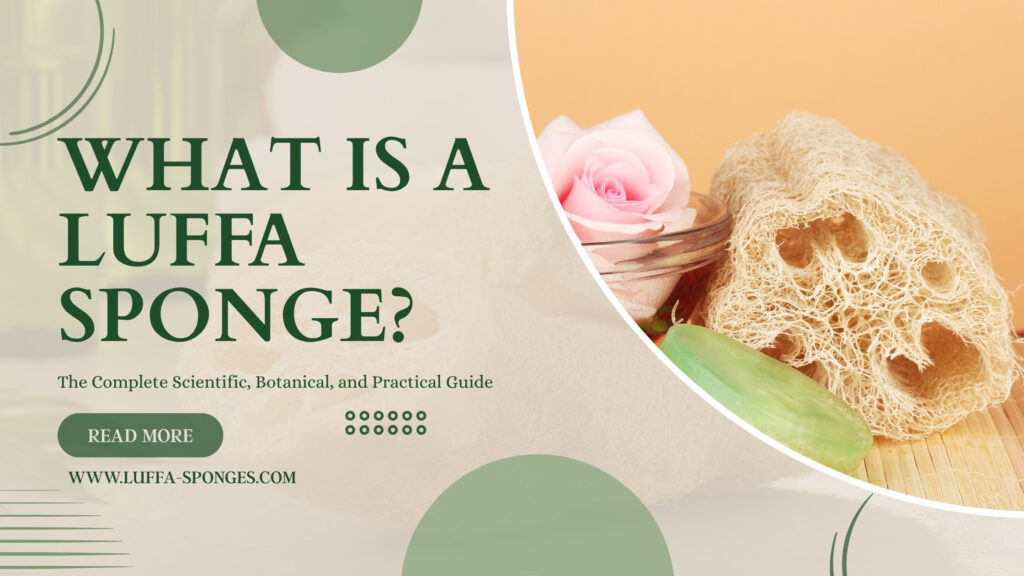
Most people assume a luffa sponge comes from the ocean. It does not. A luffa sponge is the fibrous skeleton of a mature fruit from the Luffa genus, a tropical vine in the Cucurbitaceae family that shares its lineage with cucumbers, melons, and gourds. Understanding what a luffa sponge truly is matters whether you are sourcing thousands of units for a retail brand, developing new industrial applications, or simply choosing a more sustainable scrubber for your kitchen sink.
That growth is driven by plastic reduction regulations, consumer demand for biodegradable alternatives, and expanding commercial uses that extend far beyond the bathtub. Researchers are studying luffa fiber for composite materials and water filtration. Hospitality chains are replacing synthetic amenities with Egyptian luffa. Home gardeners are growing their own sponges from seed.
This guide covers the full picture. You will learn the botanical science behind luffa, how it grows and gets processed, what separates premium Egyptian luffa from other origins, and how to evaluate quality whether you are placing a 50,000 unit wholesale order or picking one up at your local farmers market. We include comparison tables, processing steps, and practical care instructions backed by insights from EGEXO, an Egyptian loofah exporter since 2015.
Whether you want to explore wholesale options or simply learn more about this remarkable plant, this is the most comprehensive luffa resource you will find.
The Botanical Science Behind the Luffa Sponge
Understanding what a luffa sponge is begins with the plant itself. The genus Luffa belongs to the family Cucurbitaceae, the same plant family that includes watermelons, pumpkins, and zucchini. There are roughly seven recognized species within the genus, but only two are commercially significant for sponge production.
Luffa aegyptiaca vs. Luffa acutangula
Luffa aegyptiaca, also called Luffa cylindrica, is the species that produces the smooth, cylindrical sponges most people recognize. It grows as an annual climbing vine that can reach 5 to 9 meters in length under favorable conditions. The fruit develops over 120 to 200 days depending on climate, and the fibrous vascular network inside the mature fruit becomes the sponge.
Luffa acutangula, known as ridged or angled luffa, is primarily cultivated as a culinary vegetable in South and Southeast Asia. While it also produces internal fibers, the structure is less dense and less suitable for scrubbing applications. Nearly all commercial luffa sponge production worldwide relies on Luffa aegyptiaca.
The species name aegyptiaca reflects the historical importance of Egypt in luffa cultivation. Egyptian growing conditions, particularly in the Nile Delta region, produce some of the finest fiber structures found anywhere in the world. The combination of rich alluvial soil, consistent sunlight of 10 to 12 hours daily during the growing season, and traditional cultivation knowledge passed through generations creates a product with a natural, flexible fiber.
For a deeper understanding of how origin impacts quality, the EGEXO quality standards page details the measurable differences between Egyptian luffa and other sources.
Fiber Structure and Composition
The luffa sponge is composed primarily of cellulose (about 60 percent), hemicellulose (around 20 percent), and lignin (approximately 10 to 15 percent), with the remainder consisting of pectin, ash, and moisture. This composition gives luffa fiber its unique combination of flexibility when wet and firmness when dry.
Under magnification, luffa fibers reveal a complex three-dimensional network of interconnected vascular bundles. This network creates the open-cell structure that makes luffa effective for scrubbing, water absorption, and even industrial filtration. A single mature luffa fruit contains approximately 20 to 40 individual vascular bundles arranged in a cylindrical matrix.
This natural architecture is what makes a luffa sponge fundamentally different from synthetic alternatives. Synthetic sponges rely on petroleum-derived foams with uniform pore sizes. Luffa fibers create irregular, overlapping channels that trap debris mechanically while allowing water to flow through freely. This biological design cannot be replicated synthetically at comparable cost, which is one reason industrial researchers are studying luffa composites for engineering applications.
How Luffa Sponges Are Grown, Harvested, and Processed
The journey from seed to finished sponge involves precise timing and careful handling. For wholesale buyers evaluating suppliers, understanding this process reveals where quality is won or lost. For consumers and growers, it explains why some luffa sponges feel soft and uniform while others are coarse and inconsistent.
Growing Conditions and Cultivation
Luffa thrives in tropical and subtropical climates with temperatures between 25 and 35 degrees Celsius. The vine requires full sun, consistent moisture, and a sturdy trellis or support structure since the fruit grows best when hanging freely. Commercially, rows are spaced 1.5 to 2 meters apart with vertical supports reaching 2 to 3 meters high.
Egyptian cultivation in the Nile Delta benefits from naturally fertile soil enriched by thousands of years of alluvial deposits. This eliminates the need for heavy chemical fertilization that other growing regions often require. EGEXO manages its own farmland and works with partner growers across the Delta region. You can see this process documented on the farm to export page.
Home gardeners in USDA zones 7 through 11 can grow luffa successfully with a long growing season of at least 150 frost-free days. Starting seeds indoors 6 to 8 weeks before the last frost date gives plants a head start in shorter-season climates.
Harvesting and Processing Steps
Knowing when and how to harvest determines final sponge quality. The following table outlines each processing stage from field to finished product.
| Stage | Process | Key Details | Quality Impact |
|---|---|---|---|
| 1. Maturation monitoring | Track fruit development on the vine | Fruit matures in 120 to 200 days after pollination | Harvesting too early yields weak fibers |
| 2. Harvest timing | Pick when skin turns brown and fruit feels light | Fruit weight drops as internal moisture evaporates | Proper drying on vine produces strongest fibers |
| 3. Skin removal | Peel outer skin by hand or soak in water | Soaking for 24 to 48 hours loosens skin | Over-soaking can promote mold |
| 4. Seed removal | Shake out seeds and remove remaining fragments | Each fruit contains 30 to 100+ seeds | Incomplete seed removal causes buyer complaints |
| 5. Cleaning | Wash fibers thoroughly in clean water | Remove sap, residue, and remaining plant matter | Determines color and scent of final product |
| 6. Bleaching (optional) | Soak in dilute hydrogen peroxide solution | Creates lighter, more uniform color | Only used when a lighter color is wanted |
| 7. Drying | Air dry in direct sunlight or controlled environment | Moisture content must reach below 12 percent | Prevents mold during storage and shipping |
| 8. Grading | Sort by size, density, color, and structural integrity | Grading determines market destination | Consistent sizes help packing |
| 9. Cutting and shaping | Cut to specification for buyer requirements | Slices, pads, mitt shapes, whole sponges | Custom shapes require specialized tooling |
| 10. Packaging | Pack for retail, bulk, or private label | Compression for shipping, retail-ready for stores | Packaging quality affects shelf appeal |
For wholesale buyers seeking custom product design, stages 9 and 10 are where the most product differentiation happens. EGEXO offers custom designs and private label packaging. Start from our standard sizes or send your own dimensions.
What Sets Egyptian Luffa Apart
Not all luffa sponges are equal, and experienced buyers know this well. Growing origin affects fiber quality as significantly as grape origin affects wine. Egyptian luffa, particularly from the Nile Delta, is known for its soft fiber. Egyptian loofah is softer, with a looser fibre weave than Asian loofah.
See the complete product catalog for the full range of sizes and formats available for both wholesale and retail buyers. You can also read why choose EGEXO.
Practical Uses of Luffa Sponges Across Industries and Everyday Life
Answering what is a luffa sponge requires going beyond biology to explore the wide range of ways people and industries actually use this material. The applications span personal care, kitchen cleaning, medical research, industrial manufacturing, and even art.
Bath, Body, and Skincare
The most familiar use of luffa is as a body exfoliator. The natural fiber texture gently removes dead skin cells, stimulates blood circulation, and helps prevent ingrown hairs. Luffa is a natural exfoliating scrubber.
For personal use, rinsing the luffa thoroughly after each shower and hanging it in a dry, ventilated area helps it dry fully. Consumers looking for premium body luffa options can browse EGEXO’s bath and body collection, which includes whole sponges, sliced pads, and mitt-style products.
Spa and wellness businesses represent a major B2B segment. A mid-size spa chain may order 5,000 to 20,000 body luffa units annually for treatment rooms and retail shelves. Private label luffa manufacturing allows these brands to create their own branded product lines with custom packaging and specifications.
Kitchen and Household Cleaning
Natural kitchen luffa scrubbers have surged in popularity as consumers seek alternatives to synthetic scouring pads. Luffa fibers are abrasive enough to remove food residue from pots, pans, and countertops without scratching non-stick or glass surfaces. Unlike plastic-based scrubbers, luffa does not shed microplastic particles into waterways.
A spent kitchen luffa can go directly into a home compost bin when spent. For families making zero-waste transitions, switching kitchen sponges to luffa is one of the simplest and most cost-effective changes available.
Pet Care and Grooming
The pet care industry has discovered luffa as an excellent material for chew toys, grooming pads, and bathing accessories. Natural luffa is non-toxic, biodegradable, and provides the rough texture that supports dental health in dogs and small animals. Pet and spa grooming luffa products come in various shapes and densities designed for specific animal types.
Industrial and Research Applications
Researchers at universities across Europe, Asia, and the Americas have published studies exploring luffa fiber as a reinforcement material in polymer composites, a filtration medium for water treatment, and a scaffold for tissue engineering. The three-dimensional vascular structure of luffa provides natural porosity that synthetic materials struggle to replicate at comparable cost.
Industrial buyers procuring raw luffa scrubbers in bulk for R&D or manufacturing applications typically work directly with suppliers who can provide consistent fiber density and dimensions. EGEXO supplies raw material in both processed and unprocessed forms for technical applications.
How to Evaluate Luffa Sponge Quality: A Guide for Buyers and Consumers
Whether you are selecting a luffa for personal use or evaluating a wholesale supplier for your business, the same quality principles apply. The difference is scale and documentation.
Supplier Evaluation Checklist for B2B Buyers
| Evaluation Criteria | What to Verify | Red Flags to Watch For |
|---|---|---|
| Cultivation control | Does the supplier own or directly manage farmland | Reliance on unknown third-party growers |
| Processing facilities | Inspect or request documentation of processing operations | No facility photos or certifications available |
| Quality consistency | Request samples from multiple production batches | Samples look great but bulk orders vary |
| Export documentation | Phytosanitary certificates, export licenses, customs experience | Incomplete or delayed paperwork |
| Communication responsiveness | Test response times and detail of answers | Slow replies, vague specifications |
| Customization capability | Can they produce custom sizes, shapes, and packaging | Only stock sizes with no flexibility |
| Minimum order flexibility | Are MOQs reasonable for trial orders | Unreasonably high MOQs for first-time buyers |
| References and track record | Request client references or case studies | No verifiable business history |
| Sample availability | Will they send free or low-cost samples | Refusal to provide samples before ordering |
| Years in business | How long have they been exporting luffa products | New operations without proven track record |
Request samples to evaluate quality firsthand. Samples are paid, and the sample cost is credited to your first order of $1,000 or more, placed within 60 days.
Consumer Quality Check
For individual buyers, evaluating luffa quality is simpler but follows the same principles. A high-quality luffa sponge should feel firm but not rigid when dry, soften significantly within 30 to 60 seconds of soaking in warm water, show uniform fiber distribution when held up to light, have a clean and neutral scent, and contain no seeds, skin fragments, or dark spots. If it meets these criteria, you are holding a well-processed sponge worth its price.
Natural Luffa Sponge vs. Synthetic Alternatives
One of the most common questions people ask after learning what a luffa sponge is involves how it compares to synthetic sponges and scrubbers. The differences span performance, environmental impact, and long-term cost.
Detailed Comparison
| Factor | Natural Luffa Sponge | Synthetic Sponge or Scrubber |
|---|---|---|
| Material source | Plant-based, renewable | Petroleum-derived plastics |
| Biodegradability | 100 percent, compostable | Non-biodegradable, persists for centuries |
| Microplastic shedding | None | Sheds microplastic particles with each use |
| Exfoliation effectiveness | Excellent, natural irregular texture | Moderate, uniform pore structure |
| Scrubbing power | Medium to high | Varies by product |
| Surface safety | Safe for most surfaces including non-stick | Some types scratch delicate surfaces |
| Antibacterial treatment | None needed, dries quickly between uses | Often treated with chemical antimicrobials |
| Carbon footprint | Low, carbon-neutral when composted | High, requires fossil fuel extraction and manufacturing |
| End of life | Compostable | Landfill or incineration |
| Wholesale cost per unit | Competitive at scale | Slightly lower for basic grades |
This comparison makes clear why so many industries and consumers are shifting toward luffa. The performance matches or exceeds synthetic alternatives in most categories, while the environmental profile is dramatically better. For businesses building eco-friendly product lines, natural luffa offers both the sustainability story and the practical performance that customers demand.
Explore the full range of natural luffa products on our Products page.
FAQ Section
Q1: What is a luffa sponge made from?
A: A luffa sponge is made from the dried fibrous interior of the mature fruit of Luffa aegyptiaca, a tropical vine in the cucumber family. It is entirely plant-based and 100 percent biodegradable. The sponge forms naturally as the fruit matures on the vine and the internal vascular network develops into a dense, interconnected fiber structure. No synthetic materials or chemicals are involved in creating the raw sponge.
Q2: Is luffa the same as loofah?
A: Yes, luffa and loofah refer to the same plant and product. Luffa is the botanical and scientific spelling derived from the Latin genus name. Loofah is the more common consumer spelling used in English-speaking markets. Other regional spellings include loofa, lufa, and luffah. All refer to the natural sponge produced by the Luffa aegyptiaca plant.
Q3: How long does a natural luffa sponge last?
A: Proper care extends the life of a natural luffa sponge. Rinse the sponge thoroughly after each use, squeeze out excess water, and hang it in a well-ventilated area to dry completely between uses. Replace the sponge when fibers begin to break down or lose firmness.
Q4: What is the minimum order quantity for wholesale luffa sponges?
A: At EGEXO: No minimum order on standard products. Private label from 1,000 units. Samples are paid, and the sample cost is credited to your first order of $1,000 or more, placed within 60 days.
Q5: Why is Egyptian luffa considered the best quality?
A: Egyptian luffa from the Nile Delta region produces the finest, most uniform fiber structure due to optimal growing conditions including rich alluvial soil, consistent subtropical sunlight, and traditional cultivation techniques refined over generations. Egyptian loofah is softer, with a looser fibre weave than Asian loofah.
Q6: Can you grow luffa sponges at home?
A: Yes, luffa sponges can be grown at home in USDA zones 7 through 11 or any climate with at least 150 frost-free days. Start seeds indoors 6 to 8 weeks before the last frost. Provide full sun, consistent watering, and a sturdy trellis for the vines. Harvest when the fruit skin turns brown and the fruit feels lightweight. Peel, clean, and dry the sponge for personal use. Home-grown luffa makes an excellent zero-waste project.
Q7: Are luffa sponges hygienic and safe for skin?
A: Natural luffa sponges are safe for most skin types when maintained properly. They provide gentle exfoliation that removes dead skin cells and stimulates circulation. To maintain hygiene, rinse thoroughly after each use, allow to dry completely in a ventilated area, and replace it when the fibers wear out.
Q8: What industries use luffa sponges in bulk?
A: Major industries purchasing luffa sponges in bulk include hospitality and hotel chains, spa and wellness centers, kitchen and household cleaning brands, pet care companies, eco-packaging firms, and e-commerce retailers. Industrial and research applications are growing as scientists study luffa fiber for composite materials, water filtration, and biomedical scaffolding. The market continues to expand as plastic reduction regulations drive demand for natural alternatives.
Expert Insight from EGEXO
Since 2015 we have exported Egyptian luffa, and we have learned that the single biggest factor separating an average luffa sponge from an exceptional one is harvest timing. A luffa fruit harvested even one week too early produces fibers that lack density and break down quickly under use. Harvested too late, and the fibers become brittle and lose their flexibility when wet. We encourage both wholesale buyers and individual customers to feel the difference for themselves. Request samples and compare Egyptian luffa quality to any other source. Samples are paid, and the sample cost is credited to your first order of $1,000 or more, placed within 60 days. The fibers speak for themselves.
Conclusion
Understanding what a luffa sponge is goes far deeper than knowing it is a natural scrubber. It is a sophisticated botanical product with a complex fiber architecture, a rich agricultural history centered in Egypt, and an expanding range of applications across industries from hospitality to materials science. The quality of a luffa sponge depends on species selection, growing origin, harvest timing, processing precision, and grading standards. EGEXO has been exporting Egyptian loofah since 2015.
Whether you are a researcher exploring luffa composites, a brand builder developing a natural product line, or a consumer choosing a better sponge for your home, the science and the quality standards outlined in this guide will help you make informed decisions.
Key Takeaways:
- A luffa sponge is the dried vascular fiber network of the Luffa aegyptiaca fruit, not a sea creature or synthetic product
- Egyptian loofah is softer, with a looser fibre weave than Asian loofah
- Applications span bath and body care, kitchen cleaning, pet grooming, industrial composites, and scientific research
- Quality depends on cultivation, harvest timing, processing, and grading
- EGEXO has been exporting Egyptian loofah since 2015
Ready to experience Egyptian luffa quality?
- For Wholesale Buyers: Request a quote or download our catalog
- For Products: See our products or request samples