
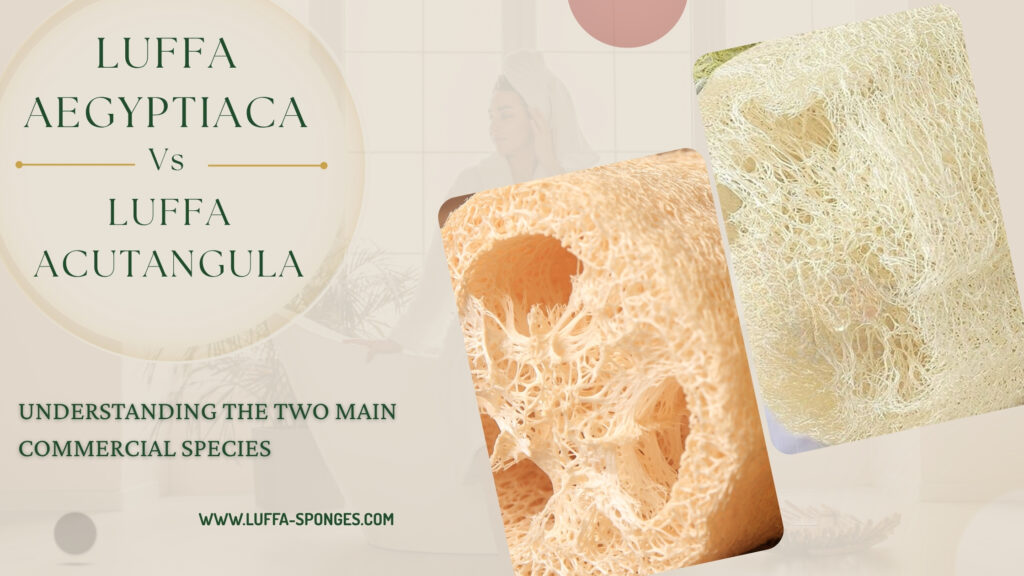
Most people who reach for a loofah in the shower have no idea they are holding the product of a specific botanical species with a distinct cultivation history, fiber structure, and commercial profile. The two species behind virtually every loofah on the market today are Luffa aegyptiaca and Luffa acutangula, and the differences between them go far deeper than their names suggest. Choosing between them, whether you are a wholesale buyer sourcing for a retail chain or a consumer trying to find the best natural sponge, starts with understanding what makes each species biologically and commercially distinct.
Luffa aegyptiaca vs Luffa acutangula is one of the most practically relevant comparisons in the loofah industry, yet it rarely gets the technical treatment it deserves. Growers selecting a variety for commercial planting, importers evaluating supplier claims, spa brands developing private label lines, and individuals trying to understand what they are buying all benefit from the same core knowledge.
This guide covers both species from the ground up, including botanical characteristics, fiber properties, cultivation requirements, processing behavior, and commercial suitability. It draws on EGEXO, an Egyptian loofah exporter since 2015.
By the end, you will know exactly which species produces which type of product, why Luffa aegyptiaca is the species behind Egyptian loofah, and how to apply that knowledge whether you are placing a bulk order or shopping for your next natural sponge.
Botanical Overview: What Each Species Actually Is
Both species belong to the Cucurbitaceae family, the same family as cucumbers, melons, and squash. They are flowering vines that produce large, elongated fruits, and in both cases, the fibrous vascular network inside the mature fruit becomes the sponge after processing. Beyond that shared foundation, the two species diverge in meaningful ways.
Luffa Aegyptiaca: The Smooth Loofah
Luffa aegyptiaca, also known as smooth luffa or Egyptian luffa, produces a cylindrical fruit with a smooth exterior surface and no prominent ridges. It is the species most widely cultivated for commercial sponge production globally, and it dominates the export markets of Egypt, China, and parts of Southeast Asia.
The interior fiber network of Luffa aegyptiaca is dense, uniformly distributed, and oriented in a way that produces a firm yet compressible sponge. This structural quality makes it the preferred species for bath and body products, spa applications, and any use case where consistent texture and durability matter. The fruit typically reaches lengths of 20 to 45 centimeters and diameters of 8 to 14 centimeters at commercial maturity.
Egypt’s cultivation of this species, particularly in the Nile Delta region, benefits from soil composition, temperature range, and seasonal humidity levels that are almost uniquely suited to producing dense fiber. EGEXO grows Luffa aegyptiaca on its own farms and partner farms in the Nile Delta.
Luffa Acutangula: The Ridged Loofah
Luffa acutangula, commonly called ridged luffa or angled luffa, is distinguished by the 10 sharp longitudinal ridges that run the length of its exterior. It is primarily cultivated as a vegetable crop across South and Southeast Asia, where the young fruit is harvested before maturity and consumed as food. Commercial sponge production from Luffa acutangula does occur but represents a much smaller share of the global loofah market than Luffa aegyptiaca.
The fiber network inside Luffa acutangula is generally coarser and less uniformly distributed than that of its smooth counterpart. The ridges that define its exterior translate into internal structural variations that can produce an uneven scrubbing surface. For certain industrial scrubbing applications, this coarser texture is acceptable or even desirable, but for premium bath products and retail-grade sponges, it presents consistent quality challenges.
Side-by-Side Species Comparison
| Characteristic | Luffa Aegyptiaca | Luffa Acutangula |
|---|---|---|
| Common Name | Smooth luffa, Egyptian luffa | Ridged luffa, angled luffa |
| Exterior Surface | Smooth, no ridges | 10 sharp longitudinal ridges |
| Fruit Length at Maturity | 20 to 45 cm | 15 to 35 cm |
| Fruit Diameter | 8 to 14 cm | 6 to 10 cm |
| Fiber Density | High, uniform | Moderate, variable |
| Fiber Network Pattern | Uniform cylindrical mesh | Irregular, ridge-influenced |
| Primary Commercial Use | Bath sponge, spa, export | Vegetable crop, limited sponge use |
| Main Cultivation Regions | Egypt, China, Southeast Asia | India, Thailand, Philippines, China |
| Preferred Climate | Warm, dry harvest season | Hot, humid subtropical |
| Days to Maturity for Sponge | 90 to 120 days | 80 to 110 days |
| Bleaching Response | Excellent, uniform whitening | Less uniform, variable result |
Fiber Structure: Why It Determines Everything Downstream
The fiber structure of each species is not just a botanical detail. It directly determines processing behavior, finished product quality, and commercial suitability. Understanding it helps buyers set accurate specifications and helps consumers understand why product performance varies so significantly across loofahs that appear similar on the surface.
How Luffa Aegyptiaca Fiber Develops
In Luffa aegyptiaca, the vascular bundles that form the sponge network are arranged in a relatively uniform cylindrical pattern throughout the fruit. As the fruit matures, this network thickens and reinforces itself, producing a sponge with consistent density from end to end. During processing, this uniform structure responds predictably to bleaching and drying, which is why it produces the consistent, export-grade white sponge that retail buyers and spa operators expect.
The fiber walls in Luffa aegyptiaca are composed primarily of cellulose with some hemicellulose and lignin, giving the dried sponge its characteristic combination of flexibility and structural integrity. When hydrated, the fiber softens sufficiently for comfortable skin contact without losing its scrubbing effectiveness.
For buyers reviewing loofah quality standards, the consistent fiber architecture of Luffa aegyptiaca is the foundation on which all grading criteria are built.
How Luffa Acutangula Fiber Develops
In Luffa acutangula, the vascular bundle arrangement is influenced by the external ridges. Fiber density concentrates along the ridge lines and decreases in the channels between them. This produces a sponge with alternating zones of higher and lower density, which translates into a scrubbing surface that feels irregular and may wear unevenly over time.
The bleaching response also differs. Because fiber density is not uniform, bleaching solutions penetrate some areas more deeply than others, resulting in color variation that makes consistent cosmetic grading more difficult. For industrial applications where appearance is secondary to function, this is less of a concern. For consumer products and branded retail lines, it creates quality control challenges that most exporters prefer to avoid.
Cultivation Requirements: What Each Species Needs to Thrive
Growing conditions shape fiber quality as much as genetics do. Both species require warm temperatures and adequate water during the growing phase, but their optimal environments differ in ways that matter for commercial cultivation planning.
Climate and Soil Requirements
| Growing Factor | Luffa Aegyptiaca Optimum | Luffa Acutangula Optimum |
|---|---|---|
| Temperature Range | 25 to 35 degrees Celsius | 28 to 38 degrees Celsius |
| Annual Rainfall or Irrigation | 600 to 800 mm equivalent | 800 to 1,200 mm equivalent |
| Soil Type | Sandy loam, well-drained | Loamy, moisture-retentive |
| Soil pH | 6.0 to 7.0 | 5.5 to 7.0 |
| Harvest Season Humidity | Low, below 50 percent ideal | Moderate to high acceptable |
| Altitude Tolerance | Sea level to 800 m | Sea level to 1,200 m |
| Frost Tolerance | None | None |
| Vine Support Required | Yes, trellis system | Yes, trellis system |
Egypt’s Nile Delta region consistently delivers the low harvest-season humidity that Luffa aegyptiaca needs for optimal field drying. This is not replicable in most Southeast Asian growing regions, where higher ambient humidity during harvest forces more reliance on mechanical drying, which introduces variability that natural field drying does not. See the EGEXO farm-to-export process for how our loofah is grown and exported.
Yield and Commercial Viability
Luffa aegyptiaca typically yields between 8,000 and 15,000 fruits per hectare under optimized commercial cultivation, depending on variety selection, trellising system, and irrigation management. Luffa acutangula yields are comparable when grown as a vegetable crop, but sponge-grade yield is significantly lower because fewer fruits are allowed to reach full maturity before harvest for food markets.
For growers and commercial buyers evaluating supply reliability, the dedicated sponge production orientation of Luffa aegyptiaca cultivation in Egypt represents a supply chain advantage. Egyptian farms grow specifically for the export sponge market, which means harvest timing, post-harvest handling, and processing are optimized for sponge quality rather than adapted from vegetable production practices.
Processing Behavior: How Each Species Responds to Commercial Production
The luffa sponge processing steps applied to each species produce different results, and understanding those differences helps buyers set realistic expectations and helps consumers understand why species origin matters in the final product.
Processing Comparison by Stage
| Processing Stage | Luffa Aegyptiaca Performance | Luffa Acutangula Performance |
|---|---|---|
| Field Pre-Drying | Uniform, predictable drying | Slower due to thicker ridge tissue |
| Skin Removal | Clean separation, minimal waste | Ridge tissue complicates peeling |
| Bleaching Response | Uniform whitening across fiber | Uneven penetration along ridges |
| Grading Consistency | High lot-to-lot consistency | Variable, harder to standardize |
| Moisture Retention Post-Drying | 8 to 12 percent achievable | 10 to 15 percent more common |
| Cutting and Shaping | Clean cuts, minimal fiber damage | More fiber distortion at cut edges |
| Final Product Appearance | Uniform white or off-white | Visible ridge lines may persist |
Commercial Applications: Which Species for Which Use
The species distinction is not just academic. It has direct implications for product selection across every market segment that uses loofah commercially.
Luffa Aegyptiaca: The Commercial Standard for Premium Products
Luffa aegyptiaca is the appropriate choice for any application where fiber uniformity, cosmetic appearance, and consistent user experience are requirements. That covers the vast majority of retail consumer products, spa supplies, and branded personal care lines.
The bath and body loofah range produced from Egyptian Luffa aegyptiaca is made from Egyptian Luffa aegyptiaca. Dense fiber, consistent diameter, clean bleached appearance, and reliable texture from unit to unit are the characteristics that spa operators and retail buyers can verify through pre-shipment sampling and expect to hold across full container orders.
For brands developing private label loofah products, Luffa aegyptiaca is the baseline species for any product positioned as premium, natural, or spa-grade. It is the species that supports the quality story a brand wants to tell because its physical characteristics are consistent enough to be photographed, described, and marketed reliably.
The kitchen loofah category also draws primarily from Luffa aegyptiaca, where the dense fiber network provides effective scrubbing performance on cookware and surfaces without shedding or breaking down prematurely.
Luffa Acutangula: Niche Applications and Industrial Use
Luffa acutangula finds its most appropriate commercial use in industrial scrubbing applications where coarser texture is an advantage, and in markets where it is primarily known as a vegetable crop with sponge production as a secondary output. It is not well-suited to premium retail positioning and rarely appears in export-grade bath product catalogs from quality-focused suppliers.
For raw loofah scrubbers used in industrial or agricultural contexts, Luffa acutangula may be acceptable if sourced from regions with established processing infrastructure and lot-level quality documentation. Buyers considering it for any consumer-facing application should request samples and evaluate fiber uniformity, bleaching consistency, and moisture content against the same standards applied to Luffa aegyptiaca before committing to a supply relationship.
Pros and Cons: Choosing the Right Species for Your Needs
| Factor | Luffa Aegyptiaca | Luffa Acutangula |
|---|---|---|
| Fiber Uniformity | Excellent | Moderate |
| Processing Predictability | High | Variable |
| Consumer Product Suitability | Excellent | Limited |
| Industrial Scrubbing | Good | Good to excellent |
| Supply Chain Reliability for Sponge | High (dedicated crop) | Lower (dual-use crop) |
| Bleaching Consistency | Excellent | Fair |
| Export Market Acceptance | Dominant | Niche |
| Cultivation Complexity | Moderate | Moderate |
| Availability at Scale | High | Moderate |
Buyer Evaluation Checklist: Verifying Species and Quality Before Ordering
Buyers who cannot visit a farm directly need a reliable framework for verifying species and quality claims from supplier documentation and physical samples. Use this checklist before placing any significant order.
| Evaluation Step | What to Check | Red Flag |
|---|---|---|
| Request species documentation | Supplier should confirm Luffa aegyptiaca in writing | Vague claims of “natural loofah” without species specification |
| Inspect exterior of raw or unbleached sample | Smooth surface confirms aegyptiaca; ridges confirm acutangula | Ridged surface presented as smooth-species product |
| Compress and release test | Full recovery indicates dense, uniform fiber | Partial recovery or asymmetric rebound |
| Color uniformity check | Uniform white or off-white across full surface | Brown streaks, ridge-line discoloration |
| Shake test | No seeds or fragments | Seed residue indicates incomplete processing |
| Moisture certification | Request documented moisture content below 12 percent | No documentation available |
| Lot consistency test | Measure 10 units from sample set, compare dimensions | Greater than 15 percent size variation across sample set |
| Odor assessment | Neutral, clean scent | Musty or sharp chemical smell |
Buyers can read the why choose EGEXO page. Buyers can also request samples to run their own evaluation before committing to a full order.
Historical and Cultural Context: Why These Species Developed Where They Did
Luffa aegyptiaca takes its species name directly from Egypt, reflecting the country’s long historical association with its cultivation. Archaeological evidence suggests luffa cultivation in the Nile region dates back centuries, and Egypt’s dry climate created conditions that made the transition from food crop to fiber crop a natural one. The low ambient humidity of the Egyptian harvest season meant that field drying was easy, reliable, and produced a clean, durable sponge without sophisticated infrastructure.
Luffa acutangula, by contrast, developed its commercial identity primarily as a food crop across South and Southeast Asian cuisines. In India, the Philippines, Thailand, and parts of China, ridged luffa is a widely consumed vegetable harvested young and cooked in curries, stir-fries, and soups. Sponge production from this species is largely opportunistic, using fruits that are allowed to mature past the food-harvest window rather than grown specifically for fiber.
This historical divergence explains why Luffa aegyptiaca dominates the global export sponge market and why Egyptian cultivation, specifically, consistently produces the highest-quality commercial loofah. The crop was domesticated for fiber in a climate that perfectly suits fiber production, and that alignment between species characteristics and growing environment has never been replicated at scale anywhere else.
Future Trends: Where Each Species Is Headed Commercially
The global natural personal care market has grown consistently over the past decade, and demand for biodegradable, plant-based alternatives to synthetic sponges and exfoliating products continues to expand. Luffa aegyptiaca is positioned to benefit directly from this trend, given its established quality infrastructure, export supply chains, and compatibility with premium product positioning.
Research interest in luffa fiber for industrial and biomedical applications has also intensified. Studies exploring luffa-derived cellulose for filtration media, wound dressing scaffolds, composite reinforcement, and biodegradable packaging have focused almost exclusively on Luffa aegyptiaca due to its superior fiber uniformity and processing predictability. This research trajectory suggests commercial applications beyond the bath market that could create new demand categories over the coming decade.
Luffa acutangula will likely remain primarily a food crop with secondary sponge production, occupying niche industrial scrubbing segments rather than expanding into premium consumer markets. Its structural limitations in processing and grading consistency make it a difficult competitor for Luffa aegyptiaca in any application where appearance and fiber uniformity are evaluated.
For buyers and brands looking to position themselves ahead of this market trajectory, exploring custom loofah product design options based on Luffa aegyptiaca fiber is a strategic starting point. The complete wholesale product catalog from EGEXO provides the full range of current product formats and specifications built from Egyptian Luffa aegyptiaca.
FAQ Section
Q1: What is the main difference between Luffa aegyptiaca and Luffa acutangula? A: Luffa aegyptiaca, or smooth luffa, has a smooth exterior and produces a dense, uniformly structured fiber network ideal for commercial bath and spa products. Luffa acutangula, or ridged luffa, has 10 sharp exterior ridges that create an irregular internal fiber pattern better suited to vegetable consumption than premium sponge production. Luffa aegyptiaca dominates the global export sponge market, accounting for approximately 85 percent of commercially traded loofah sponges, while Luffa acutangula represents the remaining 15 percent, primarily in niche and industrial applications.
Q2: Which luffa species is better for bath and body use? A: Luffa aegyptiaca is significantly better for bath and body applications. Its uniform fiber structure produces a consistent scrubbing texture across the entire sponge surface and responds predictably to bleaching. For consumers seeking a comfortable, effective, and long-lasting natural sponge, Egyptian-grown Luffa aegyptiaca is a good choice. Browse the bath and body loofah collection.
Q3: Can I tell the two species apart just by looking at the finished sponge? A: In most cases, yes. Luffa aegyptiaca produces a smooth, cylindrical sponge with no visible ridges on the exterior surface. Luffa acutangula sponges often retain faint ridge-line markings even after processing, and the scrubbing surface may feel noticeably more irregular. In bleached white products, color variation along former ridge lines is another indicator of Luffa acutangula origin. If you are evaluating an unprocessed or minimally processed sample, the exterior ridge pattern is unambiguous and immediately distinguishes the two species.
Q4: Why is Egyptian Luffa aegyptiaca considered the best quality for commercial export? A: Egypt’s Nile Delta growing environment provides the low harvest-season humidity that Luffa aegyptiaca needs for optimal field drying, which preserves fiber alignment and density in a way that more humid climates cannot replicate. Egyptian loofah is softer, with a looser fibre weave than Asian loofah.
Q5: Is Luffa acutangula safe for kitchen use? A: Luffa acutangula can be used for kitchen scrubbing applications, particularly in industrial or less appearance-sensitive contexts where its coarser texture may actually provide effective abrasion on cookware surfaces. However, its irregular fiber distribution and lower processing consistency make it less predictable than Luffa aegyptiaca for standardized kitchen products. For retail kitchen loofah products, Luffa aegyptiaca is the preferred species because it delivers consistent performance and appearance across production batches. See the kitchen loofah range for examples of properly processed, species-verified kitchen products.
Q6: What should wholesale buyers specify when ordering to ensure they receive Luffa aegyptiaca? A: Buyers should explicitly request Luffa aegyptiaca in their purchase order specifications and ask suppliers to confirm species in writing as part of the product documentation package. Requesting unbleached or minimally processed samples before committing to a bleached order allows visual species verification through exterior surface inspection. Request a quotation from EGEXO for product specifications.
Q7: Are there any medical or research applications where Luffa aegyptiaca is preferred over Luffa acutangula? A: Yes. Research into luffa-derived cellulose for biomedical scaffold materials, wound dressing applications, and filtration media has focused predominantly on Luffa aegyptiaca because its uniform fiber geometry produces more predictable and reproducible results in laboratory and applied research settings. The controlled porosity and consistent fiber dimensions of Luffa aegyptiaca make it more suitable for applications requiring standardized material properties. Luffa acutangula’s irregular fiber distribution introduces variability that complicates research reproducibility and industrial scale-up of biomedical applications.
Q8: Which species do pet grooming and spa loofah products use? A: Premium pet grooming and spa loofah products use Luffa aegyptiaca almost exclusively. The uniform fiber texture is gentle enough for sensitive skin applications, whether human or animal, while still providing effective cleaning and mild exfoliation. The consistent cosmetic appearance also matters for branded pet and spa products, where presentation is part of the value proposition. See the pet and spa grooming loofah range for products sourced from verified Egyptian Luffa aegyptiaca.
Expert Insight from EGEXO
Since 2015 we have exported Egyptian loofah, and one pattern holds true: the buyers who understand species differences make better purchasing decisions and have fewer shipment disputes. The most common confusion we encounter is importers receiving Luffa acutangula from opportunistic suppliers and comparing it unfavorably to Egyptian Luffa aegyptiaca without realizing they are evaluating entirely different products. Species verification should be the first step in any supplier evaluation, not an afterthought. At EGEXO, our loofah is Luffa aegyptiaca, grown for the sponge market. If you are not sure what species you have been buying, request a sample comparison before your next order. If you want Egyptian luffa for your brand, request a quote.
Conclusion
The comparison of Luffa aegyptiaca vs Luffa acutangula comes down to a straightforward commercial reality: one species was domesticated for fiber production in a climate that optimizes fiber quality, and the other was domesticated primarily as a food crop in conditions that produce inconsistent results when converted to sponge production. For any application where fiber uniformity, processing consistency, and availability matter, Luffa aegyptiaca is the clear choice.
Whether you are a wholesale buyer building a private label bath product line, a spa operator sourcing consistent supplies, or a consumer trying to understand why your loofah feels different from one purchase to the next, the species distinction explains most of what you are experiencing.
Key Takeaways:
- Luffa aegyptiaca produces uniform, dense fiber ideal for premium bath, spa, and commercial products
- Luffa acutangula is primarily a food crop with limited and inconsistent sponge production
- Egyptian cultivation of Luffa aegyptiaca sets the global quality standard due to climate and cultivation expertise
- Species verification should be a standard requirement in any wholesale loofah purchasing process
Ready to experience Egyptian loofah quality?
- For Wholesale Buyers: Request a quote or download our catalog
- Products: See our products or request samples