
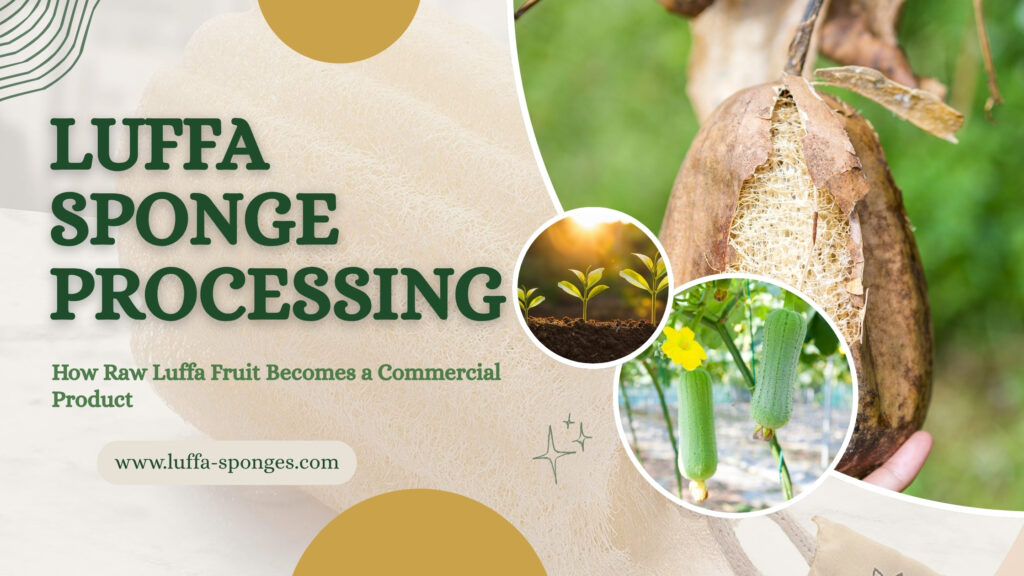
Most people have held a loofah sponge without ever wondering what it took to get there. The truth is, what starts as a green, cucumber-like fruit dangling from a vine in an Egyptian field goes through a surprisingly precise series of transformations before it reaches a spa shelf, a wholesale pallet, or a bathroom wall hook. Understanding the full luffa sponge processing steps matters whether you are sourcing for a retail chain, developing a private label product, or simply trying to understand why some loofahs feel coarse and brittle while others are dense, resilient, and long-lasting.
The difference comes down almost entirely to how the fruit was handled between harvest and packaging. Poor timing, inadequate drying, rushed bleaching, or improper grading can ruin an otherwise high-quality crop. Done correctly, luffa processing transforms a perishable vegetable into a durable, biodegradable product that holds commercial value for months or years.
This guide walks through every stage of that transformation with the level of detail that growers, technical buyers, R&D teams, and serious consumers actually need. By the end, you will understand exactly what separates commodity-grade luffa from export-quality Egyptian loofah, and what to look for when evaluating any supplier or product.
If you are a wholesale buyer evaluating suppliers, explore the EGEXO farm-to-export process to see how these standards translate into consistent bulk orders. If you are a consumer looking for finished products, see our products.
What Luffa Actually Is Before Processing Begins
Luffa, sometimes spelled loofah, belongs to the Cucurbitaceae family and is botanically classified under the genera Luffa aegyptiaca (smooth luffa) and Luffa acutangula (ridged luffa). The fibrous skeleton that becomes a sponge is not the fruit itself but the vascular network inside it, made primarily of cellulose. When the fruit matures and dries, this network remains while the outer skin, seeds, and pulp are removed.
Egypt has cultivated luffa on a commercial scale for decades. The Nile Delta region offers the ideal combination of sandy loam soils, warm temperatures, and low humidity during the harvest window, all of which support proper field drying. EGEXO has been exporting Egyptian loofah since 2015.
Why Egyptian Luffa Outperforms Other Origins
The fiber density of Egyptian luffa is measurably higher than most competing origins. Lower ambient humidity during the drying phase allows moisture to leave the fruit gradually rather than unevenly, which preserves fiber alignment and reduces brittleness. The result is a sponge that exfoliates effectively without tearing and holds its structural shape through repeated wet-dry cycles.
For technical buyers comparing origins, Egyptian luffa consistently scores higher on tensile strength, fiber uniformity, and post-processing cleanliness. For consumers, that translates into a product that lasts longer and performs more consistently than loofahs sourced from higher-humidity regions.
The Complete Luffa Sponge Processing Steps: From Field to Final Product
The processing sequence below represents the industry standard for commercial-grade luffa, refined through decades of agricultural and manufacturing practice. Each step directly affects the quality of the finished sponge.
Step 1: Harvest Timing and Maturity Assessment
Harvest timing is the single most consequential decision in luffa processing. Fruits harvested too early contain too much moisture and immature fiber. Harvested too late, the outer skin becomes overly adherent and difficult to remove cleanly.
The optimal harvest window occurs when the fruit begins to yellow at the base and feels noticeably lighter than green fruits of the same size. Experienced growers press lightly on the surface; a slight give with papery resistance indicates readiness. In Egypt, this window typically falls between 90 and 120 days after transplanting, depending on variety and seasonal conditions.
Harvesting is done by hand to avoid bruising, which can cause uneven drying and localized fiber damage. Fruits are collected in open-weave baskets that allow airflow and are transported to processing areas within hours of harvest.
Step 2: Field Pre-Drying and Initial Moisture Reduction
Before any mechanical processing begins, harvested fruits undergo a field pre-drying phase. Fruits are laid out in single layers on raised wooden or wire mesh racks in open, well-ventilated areas. Direct sun exposure combined with low ambient humidity accelerates surface moisture evaporation.
This stage typically lasts 5 to 15 days depending on fruit size and weather conditions. The goal is to reduce internal moisture to a level where the outer skin begins to shrink and separate from the fibrous core. Rushing this step through artificial heat, without controlling humidity, is one of the most common causes of mold contamination in lower-quality luffa.
| Pre-Drying Conditions | Optimal Range | Effect on Quality |
|---|---|---|
| Temperature | 28 to 38 degrees Celsius | Accelerates moisture loss evenly |
| Relative Humidity | Below 50 percent | Prevents surface mold formation |
| Duration | 5 to 15 days | Depends on fruit size and wall thickness |
| Rack Height | 40 to 80 cm off ground | Ensures uniform airflow on all sides |
| Sun Exposure | 6 to 10 hours per day | Promotes natural bleaching effect |
Step 3: Peeling and Skin Removal
Once pre-drying is complete, the outer skin is removed by hand or with simple mechanical peeling tools. At commercial scale, workers apply downward pressure at the stem end and strip the skin toward the blossom end in a single motion. Skilled workers can process dozens of fruits per hour without damaging the underlying fiber.
Skin removal exposes the raw fibrous skeleton, which at this stage is still tan or light brown and contains residual pulp and seed cavity material. Any skin fragments left on the fiber will interfere with the subsequent washing and bleaching steps, so quality-focused processors inspect each sponge individually after peeling.
Step 4: Seed Removal and Core Cleaning
Seeds are shaken or tapped out through the open ends of the sponge. A light rinse under running water loosens remaining seed fragments and softens residual pulp attached to the inner fiber walls. This rinsing step also provides the first look at the actual fiber quality: clean, dense fiber networks indicate a mature, well-grown fruit; loose, sparsely distributed fiber suggests under-maturity or variety-related issues.
For buyers assessing loofah quality standards, this stage is where grading begins. Sponges with uneven fiber distribution, internal voids, or significant fiber breakage are separated and downgraded before any further investment in processing.
Step 5: Washing and Bleaching
Washed sponges go through a controlled bleaching process to achieve the pale, uniform color that commercial markets expect. The most widely used method involves soaking in a diluted hydrogen peroxide solution, which simultaneously whitens the fiber and sanitizes the sponge.
The concentration and soaking duration must be tightly controlled. Over-bleaching weakens cellulose fibers, causing brittleness and accelerated degradation in use. Under-bleaching leaves residual organic matter that can support bacterial growth and produces an off-white or brownish appearance that retail buyers reject.
| Bleaching Method | Concentration | Duration | Fiber Impact |
|---|---|---|---|
| Hydrogen Peroxide | 3 to 6 percent | 30 to 90 minutes | Minimal if controlled properly |
| Chlorine Bleach | 1 to 2 percent | 15 to 30 minutes | Higher risk of fiber weakening |
| Natural Sun Bleaching | Not applicable | 10 to 20 days | Gentlest method, slowest result |
| Combined Method | Low concentration | Shorter soak plus sun | Balance of speed and fiber integrity |
Natural or minimally processed luffa for eco-conscious consumers and certain specialty markets skips chemical bleaching entirely, relying only on extended sun exposure. These products retain a golden or tan color and command premium pricing in natural product markets.
Grading, Sizing, and Quality Classification
After bleaching and a final rinse, sponges move into the grading phase. This is where commercial processing differs most from artisanal production.
Grading Criteria and Standards
For wholesale buyers, you can read our quality standards and order paid samples through the sample request program.
Sizing and Dimensional Specifications
Commercial luffa is sized by length and diameter after drying. These measurements determine end-use suitability and affect packaging configurations for bulk shipments.
| Product Type | Length Range | Diameter Range | Typical Application |
|---|---|---|---|
| Whole Bath Loofah | 15 to 30 cm | 8 to 14 cm | Body scrubbing, shower use |
| Mini Facial Luffa | 5 to 10 cm | 5 to 8 cm | Facial exfoliation |
| Kitchen Scrubber Slice | 2 to 4 cm thick | 8 to 12 cm | Dish and surface scrubbing |
| Luffa Pad | 10 to 15 cm | 10 to 15 cm | Back scrubbing, spa treatments |
| Industrial Roll | Variable | Variable | Surface prep, packaging |
The bath and body loofah range and kitchen loofah category at EGEXO reflect these size specifications, each selected for performance in its target application.
Drying, Moisture Control, and Final Preparation
After bleaching and grading, sponges must be dried to a final moisture content that prevents mold during storage and shipping. This is a step that separates experienced exporters from opportunistic ones.
Final Drying Methods and Moisture Targets
| Drying Method | Final Moisture | Duration | Equipment Required |
|---|---|---|---|
| Solar Tunnel Drying | 8 to 12 percent | 2 to 4 days | Tunnel structure, airflow management |
| Industrial Hot Air | 8 to 10 percent | 4 to 8 hours | Drying chambers, temperature controls |
| Ambient Air Drying | 10 to 15 percent | 5 to 10 days | Racks, low humidity environment |
| Combination Method | 8 to 10 percent | Variable | Tunnel plus ambient finishing |
Moisture content above 14 percent at the time of packaging creates conditions for mold growth during transit, especially in container shipping where temperature fluctuations occur.
From Processing to Product: Cutting, Customization, and Packaging
Whole dried sponges are the raw material for a wide range of finished products. Commercial processors cut, shape, bind, or laminate luffa to meet specific product requirements across the bath, kitchen, skincare, and pet markets.
Product Transformation Options
Raw loofahs can be processed into remarkably diverse formats. Slicing produces rounds used in kitchen scrubbers. Halving and shaping creates facial pads. Laminating with other natural materials produces multi-layer exfoliating products. Cutting to custom dimensions enables private label formatting for branded products.
EGEXO supports full custom loofah product design and private label loofah manufacturing, meaning buyers can specify exact dimensions, configurations, branding, and packaging without managing any part of the processing themselves.
Packaging Specifications for Bulk and Retail
| Format | Unit Count | Carton Weight | Shelf Life |
|---|---|---|---|
| Bulk Whole Loofahs | 50 to 200 per carton | 5 to 15 kg | 18 to 24 months |
| Retail Poly-Bagged Units | 1 to 3 per bag | Variable | 18 to 24 months |
| Private Label Boxed Sets | 1 to 6 per box | Variable | 12 to 18 months |
| Sliced Kitchen Packs | 3 to 10 per pack | Variable | 18 to 24 months |
Quality Control Checklist for Buyers Evaluating Processed Luffa
Before committing to any supplier or product line, use the following checklist to assess the quality and consistency of processed luffa.
| Evaluation Criterion | What to Check | Why It Matters |
|---|---|---|
| Fiber Density | Squeeze and release: sponge should spring back fully | Indicates mature harvest and proper drying |
| Color Uniformity | No dark spots, no brown streaks on white grade product | Signals consistent bleaching and clean processing |
| Moisture Content | Ask the supplier for the moisture level: target below 12 percent | High moisture causes mold in transit and storage |
| Seed Residue | Shake product: no seeds or fragments should fall out | Indicates thorough cleaning |
| Smell | Natural, neutral scent: no musty or chemical odor | Musty indicates mold; sharp chemical smell means over-bleaching |
| Structural Integrity | Pull gently at ends: no fiber separation | Fiber cohesion predicts product lifespan |
| Size Consistency | Measure 10 units from a sample set | Variation above 15 percent indicates poor grading |
| Packaging Integrity | No tears, moisture inside packaging, or compression damage | Affects presentation and shelf life |
Buyers can read the why choose EGEXO page.
Industrial and Specialty Processing Applications
Beyond the bath and kitchen markets, processed luffa has expanded into industrial and agricultural applications that demand even more precise processing standards.
Emerging Industrial Uses of Processed Luffa
Processed luffa fiber is being studied and applied across several technical fields. Its open-cell structure and high surface area make it useful as a filtration medium for water treatment systems. Researchers have explored its use as a scaffold material in controlled tissue engineering environments due to its biocompatibility and fiber geometry. Agricultural applications include use as a seed germination medium and soil amendment in composted form.
For raw loofah scrubbers used in industrial applications, processing standards focus on uniformity and cleanliness rather than cosmetic appearance, and suppliers must demonstrate lot-to-lot consistency in fiber density and moisture content.
The pet and spa grooming category represents another specialized processing stream, where luffa is cut, sanitized, and configured specifically for veterinary and grooming market requirements.
Supplier Evaluation: What the Processing Steps Reveal
Understanding processing steps gives buyers a framework for evaluating suppliers that goes far beyond catalog browsing. A supplier who cannot explain their bleaching concentration, drying duration, or moisture certification process is signaling a lack of process control, regardless of how professional their website appears.
Buyers ready to talk to EGEXO can request a quotation or download the product catalog to see the full product range.
FAQ Section
Q1: What are the main luffa sponge processing steps in commercial production? A: The core luffa sponge processing steps are harvest timing assessment, field pre-drying, skin removal, seed cleaning, washing, bleaching or natural whitening, grading by density and shape, final moisture drying, cutting or shaping for end-use formats, and packaging. Each step directly affects the fiber quality, cleanliness, and shelf life of the finished product. Skipping or rushing any step produces a lower-grade sponge that underperforms in use and has a shorter lifespan.
Q2: How do I know if a processed luffa has been bleached too aggressively? A: Over-bleached luffa feels brittle and papery rather than dense and springy. It may also have a faintly sharp chemical odor. When squeezed and released, it will not return to its original shape fully. Under a lighted examination, the fibers may appear thin or translucent in areas rather than uniformly opaque. Requesting a pre-shipment sample and performing a compression-recovery test is the most reliable way to detect over-bleaching before committing to a bulk order.
Q3: What moisture content should commercially processed luffa have before packaging? A: Commercially processed luffa should have a final moisture content between 8 and 12 percent before packaging. Moisture above 14 percent creates conditions for mold growth during storage and container shipping.
Q4: Why does Egyptian luffa have a better reputation than luffa from other countries? A: Egyptian luffa benefits from the Nile Delta’s low-humidity harvest season, which supports gradual, even field drying that preserves fiber alignment and density. Egyptian loofah is softer, with a looser fibre weave than Asian loofah.
Q5: Can processed luffa be customized for private label products? A: Yes. Processed luffa can be cut to custom dimensions, shaped, laminated with other materials, and packaged according to brand specifications. EGEXO supports full private label manufacturing and custom product design, allowing brands to specify cut dimensions, packaging format and labeling. This is particularly valuable for spa brands, retail chains, and eco-product companies seeking differentiated products without managing raw material sourcing or processing directly.
Q6: How long does a properly processed luffa sponge last in use? A: A properly processed luffa lasts longer when it is rinsed thoroughly after each use, wrung out, and allowed to dry between uses. Industrial and kitchen-grade processed luffa used for scrubbing surfaces may last longer since it is not subjected to the biological environment of skin contact.
Q7: What is the minimum order quantity for bulk processed luffa from a commercial supplier? A: At EGEXO: No minimum order on standard products. Private label from 1,000 units.
Q8: Is there a difference in processing between luffa for bath use and luffa for kitchen use? A: Yes. Bath-grade luffa is bleached to a higher cosmetic standard and graded more strictly for shape and fiber uniformity since it contacts skin. Kitchen luffa processing prioritizes structural density and durability over cosmetic appearance, and slicing is standardized for grip and surface contact with cookware and dishes. Both go through the same core processing steps, but quality thresholds and cut specifications differ significantly between the two applications.
Expert Insight from EGEXO
Since 2015 we have exported Egyptian loofah, and we have learned that the processing window immediately after harvest is where most quality problems either begin or get prevented. The two most common mistakes we see from lower-quality suppliers are harvesting before full maturity to increase yield volume and rushing the pre-drying phase to meet shipment schedules. Both decisions save time upfront and cost quality on the back end. Egyptian growing conditions give us a natural advantage in the drying phase, but that advantage only holds when harvest timing is disciplined and the fiber is given the full drying cycle it needs. Every product is checked before packing. If you want Egyptian luffa for your brand, request a quote.
Conclusion
Luffa sponge processing is not a single action but a sequence of decisions, each building on the last. From harvest timing through final drying, every luffa sponge processing step either adds to or subtracts from the quality of the finished product. Understanding this sequence gives buyers the ability to evaluate suppliers on substance rather than surface presentation, and gives consumers a reason to pay attention to where their loofah came from and how it was handled.
EGEXO has been exporting Egyptian loofah since 2015. Our loofah comes from our own farms and partner farms and is processed in our own factory.
Key Takeaways:
- Harvest timing and field pre-drying are the two most critical luffa sponge processing steps for fiber quality
- Moisture content at packaging must be below 12 percent to prevent mold during shipping and storage
- Egyptian luffa outperforms other origins due to climate advantages during the drying phase
- Bleaching concentration and duration directly determine fiber strength and longevity
- Grading consistency separates commodity suppliers from export-quality producers
Ready to experience Egyptian loofah quality?
- For Wholesale Buyers: Request a quote or download our catalog
- Products: See our products or request samples