
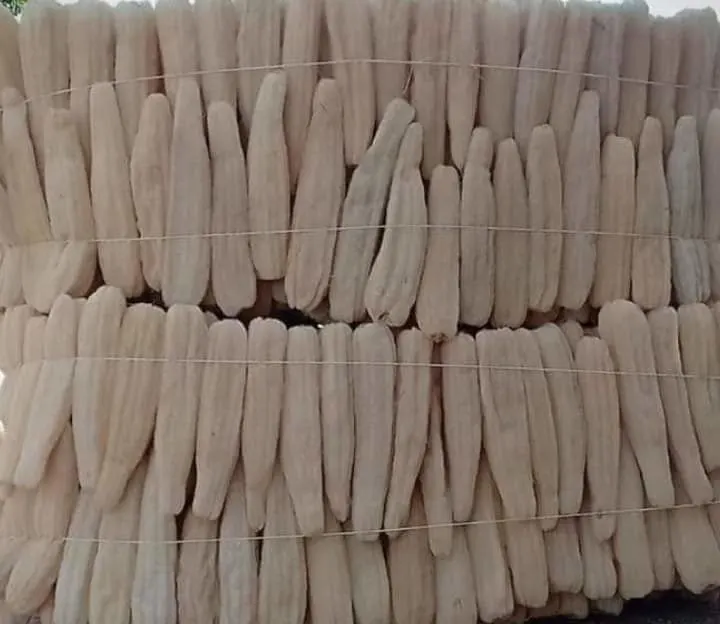
The luffa plant is a fast-growing climbing vine in the gourd family. It makes yellow flowers, then long green fruits, and if a fruit is left to ripen and dry on the vine, the inside turns into the fibre network we call a loofah sponge. This guide follows the luffa plant from seed to finished fibre.
Quick facts
- The luffa plant used for loofah sponges at EGEXO is Luffa aegyptiaca.
- Loofah is the dried fibre network inside a ripe luffa fruit, and it is 100% biodegradable.
- EGEXO loofah comes from its own farms and partner farms in the Nile Delta.
- Loofah does not require heavy pesticide or fertilizer.
- EGEXO For Export has been exporting loofah from Damanhour, Egypt since 2015.
What kind of plant is luffa?
Luffa, also spelled loofah, is an annual climbing vine. It belongs to the gourd family, so it is a relative of cucumbers, squash and melons. It likes warm weather and plenty of sun, and it usually grows well where the season is long and hot. The vine climbs by curling tendrils, which grab on to whatever support is nearby.
Several species carry the name. The one used for most sponges is Luffa aegyptiaca, the smooth luffa. Another common species, Luffa acutangula, has ridged fruit and is more often eaten as a vegetable. Our post on the two main luffa species explains the difference in more detail.
How does the luffa plant grow from seed?
Growth starts with a large, dark, flat seed. In warm soil it usually sprouts without trouble. In cooler places, growers often start the seeds indoors so the plant has enough season left to finish its fruit. Once the seedling is up, the vine puts out leaves and long runners quickly and needs something strong to climb. If you want to try it yourself, our home growing guide covers the practical steps.
A healthy vine can grow to a great size in one season. It often needs steady water, warmth and a good support, and a crowded or shaded plant tends to give fewer fruits. Notes on feeding and care are in this post on luffa plant care.
How do the flowers become fruit?
A luffa vine carries two kinds of flower on the same plant. Male flowers sit in loose clusters on short stalks. Female flowers appear one at a time, and each one has a tiny fruit-shaped swelling just behind the petals. Bees and other insects move pollen from the male flowers to the female ones. When pollination works, the small swelling grows into a long fruit. When it does not, the young fruit usually turns yellow and drops.
At first the fruit is smooth, green and tender. In many countries young luffa fruit is picked at this stage and cooked as a vegetable. For sponges, the fruit is left on the vine much longer.
How does a luffa fruit turn into a sponge?
As the fruit ripens, the skin changes from green to yellow and then brown, and the fruit loses weight as it dries. Inside, the soft flesh breaks down and leaves a mesh of tough fibre wrapped around the seeds. That mesh is the loofah. Growers usually know a fruit is ready when it feels light, the skin is dry and papery, and the seeds rattle when it is shaken.
After picking, the skin is peeled away and the seeds are shaken out. The fibre is rinsed and dried again. You can read the whole sequence in our post on luffa sponge processing. The result is a piece of plant fibre that is stiff when dry and soft once it gets wet.
Which luffa species matter for sponges?
Two species are common worldwide. Luffa aegyptiaca, also called the smooth or Egyptian luffa, has smooth fruit and is the main source of bath and kitchen sponges. Luffa acutangula has ridged fruit and is grown widely for the pot. Both belong to the same plant family and look alike from a distance, but their fruit and fibre behave a little differently.
The species is only one factor. The soil, the sun, the water and the care a vine gets all shape how well the fibre forms. A strong, healthy vine with a long warm season tends to give clean, well-formed fibre, while a stressed one tends to give uneven fruit. That is why the growing conditions matter as much as the plant type.
How long is the season for a luffa vine?
A luffa vine needs a long, warm season to carry fruit all the way to the dry stage. The early weeks go into leaves and runners, then come the flowers, then the fruit, and then the long wait while the fruit ripens and dries. We give no day counts here because they change with the variety, the climate and the year.
This long timeline explains why luffa suits warm regions such as the Nile Delta. In cooler regions, growers often start seeds indoors and watch the weather at the end of the season. Late rain and cold can leave fruit damp on the vine, and a fruit that stays damp is a fruit that spoils.
What do the leaves and tendrils do?
The leaves are broad and lobed, and they collect sunlight to feed the plant. The tendrils are thin, curly shoots that grow at the leaf joints and coil around anything they touch. Together they let a light vine climb a tall support and carry a heavy crop. Without a good support, the fruit often lies on the ground and spoils, so growers give the vine a strong frame to climb.
Where does EGEXO get its luffa?
EGEXO loofah comes from our own farms and from partner farms in the Nile Delta. Once the fruits are harvested, we dry the loofah by sun drying and machine drying, and we cut and finish it in our own factory in Damanhour. Loofah does not require heavy pesticide or fertilizer, and every piece is checked by hand for colour, holes, size and dryness.
If you buy for a shop or a brand, read more about EGEXO and our farms to see how the supply works. There is no minimum order on standard products.
Frequently asked questions
What does a luffa plant look like?
It is a climbing vine with large, lobed leaves, curling tendrils and yellow flowers. The fruit is long and cylindrical and starts out green.
Is luffa a vegetable or a sponge?
It can be both. Young fruit is eaten as a vegetable in many countries, and fully ripe fruit that has dried on the vine gives the fibre used as a sponge.
Does luffa grow every year?
Luffa is usually grown as an annual, so it is sown again each season. Seeds saved from a dry fruit can be used for the next planting.
Is a loofah sponge made of plastic?
No. Loofah is plant fibre from the luffa fruit and it is 100% biodegradable.
Can I buy loofah from the farms you describe?
Yes. EGEXO exports loofah from Egypt. Ask for a quote, samples or the catalog and we reply within 24 hours.
This site is published by EGEXO For Export, a family-run exporter in Damanhour, Egypt. If you are buying for a shop or brand, see the EGEXO loofah range and ask for the catalog, samples or a quote.